
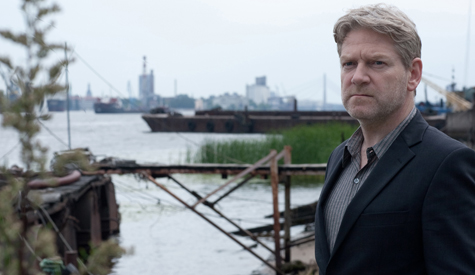
When’s the last time you watched a really good Latvian thriller?
I watched one last night.
To be fair, last night’s episode of Wallander on PBS’s Masterpiece Mystery was about the famous, fictional Swedish detective Kurt Wallander, but it was filmed almost entirely in Riga, Latvia. And it was a really good thriller. So, as far as I’m concerned it qualifies.
The suspense level was high, there was just enough pathos, and best of all it showed me places and faces I’ve never seen before. It’s a tribute to Wallander that the series is so beautifully photographed and acted you can almost overlook the gruesome corpses that surface all over the place.
We begin as two Swedish fishermen encounter what appears to be an unmanned raft on the open sea. Turns out (no surprise) the raft does have men aboard. Two of them. Wearing business suits. Both have had their fingers broken, their mouths and tongues burned away with acid, and their bodies pierced with bullets for good measure. Someone was thorough.
One fisherman wants to tow the raft to shore, the other refuses to be involved. Thus, we infer there’s an extra level of nastiness attached to these corpses. Eventually, the raft floats to shore on its own, Wallander is called to the scene, and when the medical examiner reveals that the bodies are heavily tattooed with Russian mafia insignias we begin to comprehend what we’re dealing with. But there’s a twist. According to the Russian mafia tattoo expert (for apparently there is such a person available to consult in Ystad), the ink indicates that the dead men were from Latvia.
Latvia? Wallander’s expression indicates that he’d consider Neptune less foreign.
We viewers might be less surprised by this development knowing as we do that the episode is called “The Dogs of Riga,” and Riga, as we are well aware, is the capital of Latvia. Still, beyond that bit of knowledge, most of us are probably as uninformed as Wallander is about the country.
The arrival of Latvian police inspector Karlis Liepa doesn’t provide much illumination, since Liepa won’t answer even the simplest question Wallander asks.
And you thought the Swede was impenetrable! He’s no match for a law enforcement officer who began his career when Latvia was a Soviet republic. If Liepa doesn’t want to talk, Wallander won’t be able to make him talk. Yet the more time they spend together, the more Wallander recognizes a kindred spirit in Liepa—the same sense of responsibility, the same sense of guilt, the same sense of regret that comes from allowing the job to take precedence over everything else, and the same inability to keep that from happening. So when Liepa is found dead immediately after his return to Latvia, Wallander travels to Riga to help with the investigation into Liepa’s murder.
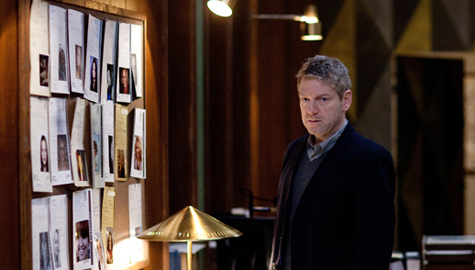
Naturally, said investigation is neither smooth nor simple. Rampant police corruption complicates things, as does Liepa’s widow Baiba. “Widows are very beautiful,” a Latvian police colonel remarks at Liepa’s funeral. This widow certainly is, and Wallander can’t help but notice. (It should be mentioned that Vanja Andersson, Wallander’s companion played by Saskia Reeves in “An Event in Autumn,” has vanished without explanation.) The language barrier doesn’t help Wallander navigate in Riga, but the biggest obstacles are that Wallander is not in charge, not at home, and utterly at the mercy of everyone around him with no idea whom to trust and whom to fear.
Latvia became independent from the Soviet Union in August 1991 and Henning Mankell’s novel, The Dogs of Riga, was published in 1992. He was writing the book while Latvia’s struggle for independence was ongoing.
The novel would have been remarkable at the time, revealing as it did some of the mysteries of the European east. Even now, more than 20 years after Latvian independence, the TV dramatization by Peter Harness captures the guardedness and secrecy that never quite leave people who were raised to distrust everyone. (I’m not certain when the episode takes place, but it’s more recent than 1999.)
That the episode was filmed in Riga was a huge plus for me, and (without spoiling anything) I thought the chase through the outdoor market was terrific. I also really appreciated the fact that the actors and actresses cast in the Latvian roles were Latvian, Romanian, and in the case of Ingeborga Dapkunaite, who played Baiba Liepa, Lithuanian born. Karlis Liepa, who might have looked familiar to you, was played by Søren Malling, from the original Danish version of The Killing.
Now, I’m wondering how to go about finding a bona fide Latvian thriller. I believe that’s worth investigating. In the meantime, I’ll reread The Dogs of Riga, and I’ll stay tuned for “Before the Frost,” the final episode of Wallander series III airing on PBS next week.
See more Wallander content on Criminal Element.
Leslie Gilbert Elman is the author of Weird But True: 200 Astounding, Outrageous, and Totally Off the Wall Facts. Follow her on Twitter @leslieelman.
Read all of Leslie Gilbert Elman’s posts for Criminal Element.
How did I miss this? I’ll have to go looking for it online. PBS does post the episodes, doesn’t it?
This link should take you there:
[url=http://video.pbs.org/video/2278262726]http://video.pbs.org/video/2278262726[/url]
Great post! I love the Kurt Walander novels but not Kenneth Branagh’s version of him, or that series. But you have persauded me to give him a second chance! I’ll look out for this production from now on!
@MWheelaghan Thank you! I can understand why Mankell purists might feel the series departs from the books too much or that Kenneth Branagh isn’t what they envision Wallander to be. At this point though, the series has grown on me. I’m looking at it independent from the books. And even on its worst days, Wallander is beautifully filmed. That’s always a pleasure to see.
There is a lot to be said for beautiful filming 🙂
This really was a thriller. I find it amazing that Wallander is gory and yet moves at a languid pace. Quite the combination. Excellent write-up of an outstanding episode.
Love Mankell’s writing and the Swedish adaptations. Branagh has done a good job bringing Mankell to a wider audience, but to me his interpretation is a tad too Shakespearean and lacks the humour of the Swedish series and the books. Quite a few Nordic authors seem to be following in his footsteps, but very few can match the quality of his writing and characterisation. Tegenfalk and Nilson-Julian are two interesting rookies. Johan Theorin is another brilliant writer who deserves more attention, especially for his first book. Found the 3rd one harder going. Nesbo off course – love the Hole character.
Sorry, should be Tegenfalk (Anger Mode) and Nilsson-Julien (The Ice Cage)
I had to react/register when I saw this. Cheers DHoward for mentioning me (and getting my name right!), but it’s not fair to compare me to a giant like Mankell. No one can match him when it comes to Nordic Crime. He is the reference. His combination of unassuming elegance and solid substance. No fancy writing, but clean, stylish, well-written. Jo Nesbo is a Prince, Larsson… equally compelling, but a different type of literature, a form of literary journalism?
I wasn’t really comparing. It seems the whole Nordic genre thing sometimes becomes a trap for authors. They have to brand themselves as the new Larsson or Mankell, when they’re actually something different. It’s about finding the right balance between repetition (genre) and variation (originality) and I think you’ve actually achieved that. The market place forces authors to keep repeating themselves/their successes, which ends up weakening the impact of their writing. Genres are dead unless they evolve (variation). I think we/readers need to practice being more open-minded, stretch our references, which Branagh does to a certain extent, but it’s good to try to watch the Swedish adaptations too, because they’re closer to Mankell in spirit. I wonder though how Mankell – being a man of the theater and Bergman’s son-in-law – looks at Branagh’s Shakespearean take. A welcome variation? His reaction is probably mentioned elsewhere on this excellent site. Will have a rummage around