

Let me start by saying I love Inspector Lewis. It’s not hip, it’s rarely believable as a police procedural, but it’s literate and beautiful to watch. I find it soothing.
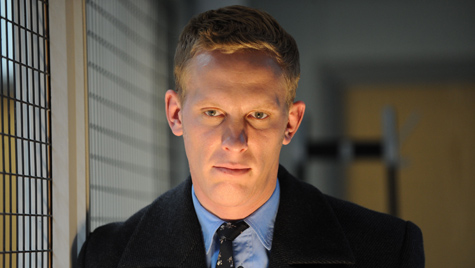
I can’t see Kevin Whately as anyone but Lewis: solid, sensible, sensitive. (That’s probably frustrating for him as an actor, I know.) Laurence Fox as Sergeant Hathaway is a master of the knowing smirk. Clare Holman as medical examiner Dr. Laura Hobson and Rebecca Front as Chief Superintendent Jean Innocent are great too—assuming they have something to do. In this episode they do not. And that’s not the only reason “Fearful Symmetry” was a clunker.
We begin, as usual, with the discovery of a murder victim. She’s delivered right on schedule—five minutes into the episode—Jessica Lake, eighteen-year-old babysitter, found lashed to a headboard with nautical rope and secured with what Sergeant Hathaway helpfully informs us is a Buntline Hitch, a knot favored by the “yachty” set.
We soon learn that the killer smothered her first, then tied her up and posed her. “This was planned. Symmetry. Each wrist tied with the rope six times. The neatness of it. He thought about this . . . a lot,” Hathaway surmises.
Sadly, poor beautiful Jessica turns out to be the only thing tied up neatly in this episode.
For starters there’s Nick and Honey Addams, the couple who hired Jessica to babysit their toddler; in whose home—in whose bed—the murdered girl was found. They come across as perversely unconcerned by the situation. Didn’t know her, she was called in to pinch hit when the regular babysitter couldn’t make it, can’t really tell you anything more than that. Turns out, Nick and Honey are preoccupied with personal problems, but even so . . . A girl was murdered in your house and your toddler was there with her when it happened! I don’t care if you are all posh and living in “the exclusive Arcadia Park estate” housing development, a shrug and an “oh well” are not an appropriate reaction in that situation.
(Special for ’80s music fans: Nick’s boss who also figures into things here is played by Gary Kemp, late of Spandau Ballet. Just thought you’d like to know.)
Jessica’s boyfriend, Gideon Massey, is also in the frame. At least her friends Kyle and Silas seem to think so. Gideon’s wealthy—his nervous wreck of a father works in an ethology lab “teaching monkeys to talk” and his estranged ice princess mother has some sort of museum-related job. He says Jessica’s friends dislike him because they think he’s privileged.
Jessica grew up “in care” at a place called Boxgrove (possibly named for an archaeological site where human remains from 500,000 BC were found). She has no family and she’s been squatting at Boxgrove—now vacant and shuttered—with Kyle and Silas. Silas clearly had a thing for her and is generally carrying around a lot of anger. We know that can’t be good.
Then we have Marion Hammond played by Lucy Cohu, whom you might recognize from Torchwood and/or from her small role in the “Pocket Full of Rye” episode of Miss Marple if you’ve watched it 12,000 times as I have.
“Professional iconoclast, social photo-anthropologist cum cultural pundit,” explains Hathaway.
“Oxford type,” nods Lewis.
“Oh yeah,” Hathaway concurs.
As Lewis soon quips, there’s “a good few bob in this iconoclasm lark.” Marion does very well for herself taking erstwhile artistic photos that would be tagged as smutty if they’d been shot by anyone other than a smooth-talking, chess-playing professional iconoclast. Jessica was one of her models and was featured in Marion’s latest exhibition, entitled “Fallen? A meditation on postlapsarian female gender identity.” (Postlapsarian. That’s my new word. More on that later.) In those photos, many of which have soft-core bondage motifs, Jessica is tied up with nautical rope. Thus we discover that whoever killed Jessica had some familiarity with the photos and possibly with Marion Hammond.
And that’s the last time things make sense. The characters are linked in an unexpectedly tight circle, yet we never have a clear sense of their individual stories or anything beyond their superficial relationship to each other. A second body turns up, also killed and posed in a gruesome manner that mirrors one of Marion’s photos. Yet when we finally learn the identity of the killer, it’s hard to imagine how or why that second—implicitly premeditated—murder was committed.
Writer/series creator Russell Lewis forgoes the usual highfalutin’ literary allusions that make Lewis so much fun. The episode title comes from William Blake’s poem “The Tyger”:
Tyger! Tyger! burning bright
In the forests of the night,
What immortal hand or eye
Could frame thy fearful symmetry?
The passage’s relation to the plot isn’t obvious, although there is a picture of a tiger hanging on Jessica’s bedroom wall.
Dr. Hobson barely registers here—all the more frustrating after last week’s episode in which she and Lewis were sparring and a little jealousy was brewing. And I do wish they’d give Superintendent Innocent something to do beyond “a scene which could accurately be entitled: Lewis’s boss gets out of a car.” (Someone else called it that, but I’m not telling who.)
And so I come away with an enhanced vocabulary—Postlapsarian: “Of, relating to, or characteristic of the time or state after the fall of humankind described in the Bible”—and not much else except hope for next week’s episode. It will be the last episode of this series and I know it’s going to bring surprises.
Read all of our coverage of Masterpiece Mystery.
Leslie Gilbert Elman is the author of Weird But True: 200 Astounding, Outrageous, and Totally Off the Wall Facts. Follow her on Twitter @leslieelman.
Read all of Leslie Gilbert Elman’s posts for Criminal Element.
I find it hard to criticize this series–I like it that much. I also find it soothing, strangely enough–from the beautiful settings to the music, it relaxes me.
I actually rewatched the pilot episode of Lewis, yesterday–and cried my eyes out, all over again, at each reference or nod or homage to Morse…/sigh
This show (Lewis) has me remembering Morse, even if he’s not referenced in some way, and for that reason, I hope we still have several more series (seasons) to go!
I agree with Leslie. I love the show more because of the endearing leads (Lewis & Hathaway) and their chemistry, plus the high production values, than for the story line. Sometimes the stories are a bit of a dog’s breakfast.
I find it hard to criticize too, but this episode really didn’t hang together for me. Too many bits and pieces that didn’t form a whole–undeveloped characters and unexplored relationships between them. And Nick and Honey’s behavior was bizarre.
On the other hand, Lewis’s remark about the dogs playing pool was a gem!
My favorite part of the whole episode was DS Hathaway singing, “Row, row, row your boat, gently down the stream; merrily, merrily merrily, merrily, life is…..somewhat repetitive…” hahahaha
Ha! Yes to all that, yet I love this show anyway. This particular itteration was a new low in plot devices (I tagged the murderer the moment he/she appeared on the screen) still one returns because I think in my own case there is a brief series of fantasies involved; one that I am an inscrutable Oxford don hovering around the environs of a murder, then I am romancing the diffident Hathaway, then I am romancing the avuncular Lewis himself. It’s all a bit odd really, postlapsarian maybe.
Good one @Staci!
Yes @AnnaZed I thought the resolution of this episode was a cheat. (No spoilers!) Not up to the standards we’ve come to expect. Then again, it’s the show’s own fault for setting the bar so high.
Still…as Bogart said, we’ll always have postlapsarian. (Did you notice it was the secret word in the closing credits?)
I haven’t watched this episode yet but, so far, Inspector Lewis can do no harm in my eyes. I hope when I finally do get to this episode that I don’t change my mind!
If it is a clunker as you say, I can just get lost in the somber gaze of Hathaway (p.s. just broke my own heart by googling Laurence Fox for the first time and discovering he’s married to Doctor Who‘s Billie Piper.):
[img]http://www.nndb.com/people/186/000348139/laurence-fox-1-sized.jpg[/img]
@Leslie Gilbert Elman – Postlapsarian? Secret word? Closing credits? I know nothing of this. Fortunately this episode is up on the PBS site to watch in its entirety (they usually have all Masterpiece shows up on the site for a few weeks) so I can watch it again or at least fast-forward to the end credits and see what you are on about. I really don’t think this particular plot can stand-up to a second viewing, but fun secret words I always have time for.
@AnnaZed Oh my goodness! Yes! Every episode has a secret word embedded in the closing credits. After the cast credits are shown and the rest of the credits start to roll, look for red letters sprinkled among the white. They spell out a word relevant to the episode. This time it was postlapsarian. As someone pointed out on the “Soul of Genius” blog, then it was Paracelsus.
Masterpiece Mystery does this for just about all of its programs: Poirot, Sherlock, etc.
Sorry Jenn, they’re hitched and they just had their second child in the spring. 🙂
Leslie, I’m finding the plots too complicated and almost impossible to follow in my down time on Sunday night although I’m a loyal fan and look forward to the elegance and seeing Lewis and Hathaway. I agree this one is a clunker. Too many red herrings. Why did they have to be teaching a primate human words? Why did they have to have a swinging foursome? I’m sleepy that time of the day and week, I couldn’t keep tract of all the names. My wide awake husband, a college professor, had the same problem. Smiles.
@Dorothy I agree. Yasmin confused me too. At the end of the episode I figured I must have missed something that would have made it make sense. So I went back and watched part of it again. Nope. Didn’t work for me then either.
@Leslie Gilbert Elman I did not know about these words and I ahve been watching Masterpiece for decards (seriously). Well, you learn something new every day.
@Dorothy, me too! What on earth was that swinging foursome thing even supposed to be about (?) and Yasmin’s role I never grasped so am glad to know that I’m not the only one.
Agree with all of you. Had to watch the episode three times and it still did not come together for me. Can anyone tell me the name of the music the choir was singing? It is so familiar but can’t think what it is.
@Lin I did look that up, but I’m not at my desk and I can’t check my notes now. I remember it was a funeral/requiem for a woman.
@Lin – In my notes I have Funeral Music for Queen Mary by Henry Purcell.
The music or piano that has been used in the pre advertisment for this Episode is so lovely, i have heard it years ago , but i just can’t remember what it is. could someone help. It is beautiful
I am somewhat late to the Lewis party but thoroughly enjoying it, can’t believe I am only getting into it now! I too find it very soothing and relaxing to watch, something beautiful about the scenery and I love the chemistry between Lewis and Hathaway, I in particular love the character of Hathaway very well played by Laurence fox. Regarding this particular episode, I wasn’t disappointed, more frustrated, the one that really bothered me was, where the heck DID nick Addams go in the car? That whole storyline was bizzare and baffling to say the least. There seemed an attempt to add to many characters into the plot and they all seemed connected but with absolutely no meaning??? I mean, the doctor in the lab was sort of a suspect but not really??? Also what was the point in introducing his secretary as his bit on the side, what was the point??? Too much confusion, dead ends, uncoordinated and bizarre, but I still enjoyed the show, isn’t that a sign of a truely great show and testiment to the acting… Can’t wait for next week!
Ps I can see why silas was killed…because of his obsession with Jessica..same as the killer….
@Oxbridge I hope you’re catching up on Inspector Lewis. We have three new episodes coming to Masterpiece Mystery in October!
I’ve just seen this episode for the first time, and am still wondering where did the husband, Nick go in the car? Did I miss that explanation? And what was the big thing that Hathaway thought Kyle, Silas and Jessica were doing that may have led to the death of Jess and Silas? Another red herring? I’m all for putting forward different possibilities to keep the viewers guessing about Whodunnit, but only when everything is explained in the end. And I’m disappointed they went with the murderer being ‘crazy’ …a lame kind of ending.