Who will Spenser be?When the news broke last year that Putnam had tapped mystery writer Ace Atkins to pen a new Spenser novel, I sat dumbfounded for a full minute.
At first, it struck me as a purely bad idea, a cheap scheme by a publisher to keep a lucrative franchise going. I mean, how can you have a Spenser book without Robert B. Parker? When the author shuffled off this mortal coil I just naturally assumed that Spenser (as well as Parker’s other series stalwart Jesse Stone) had closed for business. After all, books aren’t like movies or songs. You can’t just bring in a new actor or singer to put a different spin on the same material. A novel is the work of a novelist, and if you want Spenser, well, Parker wrote thirty-nine Spenser novels. The canon is set. As no less an authority than Otto Penzler told The Wall Street Journal, “Ace Atkins is a terrific writer, but he’s no Robert B. Parker.” Parker was a master, in short, and Spenser was his masterpiece. There’s a lot to be said for the theory that you should leave masterpieces well enough alone.
And yet…
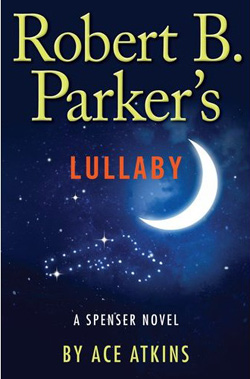
The more I think about it, the more I’m convinced that there is another way to look at this announcement. Before Atkins’s debut Spenser novel, Robert B. Parker’s Lullaby, hits shelves in May, let’s bear in mind certain things:
Big Bob probably would have wanted it this way. As anyone who has ever read an interview with Robert B. Parker knows, there is no reason to think that he was the least bit precious about his work. This guy wrote ten pages a day like he was punching a time clock, claimed never to revise, released three novels a year, and sold about 40 million books. He was, in other words, a cheerful professional. I’d lay money that he would have liked the idea that Spenser will keep on keepin’ on.
The ParkersJoan said yes. Parker’s beloved wife and constant muse, Joan (to whom he dedicated nearly all his sixty-plus novels), has blessed the decision to move ahead with new books. She’s also signed off on the selection of Atkins for the Spenser series, as well as the selection of writer Michael Brandman to continue the Jesse Stone series. To know anything about Robert B. Parker is to know that what was fine by Joan was, by definition, fine by him. Joan’s endorsement alone doesn’t make the Atkins/Brandman gamble a good idea, of course, but it is a positive sign.
Consider the Stone movies. If Michael Brandman’s name is familiar it might be because he’s been writing and producing the Jesse Stone television movies for six years now. Some of those films—like Thin Ice and No Remorse—were original stories written by Brandman. (Parker had no hand in writing them.) Now, if Brandman can write Jesse Stone movies, why can’t he write Jesse Stone novels? It seems like an arbitrary rule to say he can’t, or shouldn’t.
This kind of thing has been done before. Parker himself wrote two Philip Marlowe novels. John Gardner took a run at James Bond. Eric Van Lustbader picked up Jason Bourne. Joe Gores gave us a new Sam Spade novel. And Sherlock Holmes has been tackled by everyone from Stephen King and Caleb Carr to Loren D. Estleman and Michael Chabon.
On that last point, Holmes serves as a good illustration of a larger issue. When done well, a series character tends to take on a life of his (or her) own. No one writes Holmes as well as Doyle, but since we keep lapping up new variations on the old boy, Holmes himself must have qualities that extend beyond the excellence of Doyle’s writing. I’m sensitive to the argument that no one could ever write Spenser as well as Parker (I’m utterly convinced of it, in fact), but I must say I am intrigued by the idea that Parker might have created a character who could conceivably become as archetypal as Holmes, Spade, and Marlowe.
It’s not as if others haven’t shaped our concept of Spenser…Will it work? Who knows? You have to keep in mind the nature of Parker’s achievement with Spenser. Unlike Walter Mosley’s continuing development of Easy Rawlins, Parker did not see fit to evolve his hero beyond a certain point. You don’t turn to Spenser for originality. You turn to him for familiarity. Forget the new stuff, play your hits! This is why Spenser stopped aging sometime in the 1980s (and why he stopped talking about serving in Korea). Parker wanted the character to be the perpetual embodiment of a certain kind of emotionally aware masculinity: self-possessed and autonomous, but also selfless and capable of intimacy. These qualities found their expression in a formula as dependable as a three-minute pop song. Spenser in his office smart-mouthing a new client. Spenser and Susan Silverman flirting over dinner. Hawk showing up about halfway through, his bald head gleaming and his face coolly bemused. Spenser hilariously insulting some would-be tough guy. Spenser handing that guy his ass when the doofus can’t take a hint. And, most of all, Spenser sticking to his code of ethics even as he navigates the nasty end of the Boston underworld. You read Spenser to watch him keep being Spenser: the perfect man in an imperfect world.
But can Spenser keep being Spenser without Parker?
That remains to be seen. Parker was, after all, a singularly entertaining and witty writer. When we lost him last year, we lost one of the gentle giants of popular fiction. No one can replace him. But for now Putnam is gambling that Spenser might become something larger than a character in thirty-nine novels by Robert B. Parker. If that is true—if Spenser can continue beyond the prose and plots of the original books—then maybe it only deepens Parker’s achievement.
Robert B. Parker is one of my heroes. I miss him every day. I hope Atkins can come through for Spenser. Personally, I fear Brandman will take the heart out of Jesse Stone. The movies he wrote that were not based on books were weak and confusing. I never understood the need to move away from the books when they were such powerful, intriguing stoies.
Parker’s trademark dialogue and intricate stories may be one of a kind.
Gerald So
January 19, 2012 at 6:47 am
I’m a longtime Parker/Spenser fan, and I’ve been open to the idea of continuing Spenser [url=http://geraldso.blogspot.com/2011/01/end.html]for a year now[/url]. To me, Spenser casts too long a shadow on contemporary P.I. fiction to die with Parker.
In a way, Spenser had already grown beyond Parker with TV’s SPENSER: FOR HIRE. Parker was credited as “Creative Consultant” but claimed that simply meant he cashed a check every week. TV made some changes to the characters that didn’t sit well with me, but the show did well enough on its own to run for three seasons (1985-88).
As you point out, the Jesse Stone movies also have a continuity independent of the books. I think that was a good decision, given that Tom Selleck is much older than the Stone of the books, and if the movies followed the books to the letter, they would hold no surprise for faithful readers.
I can’t muster much interest in Brandman’s Stone novels, and what I’ve read of KILLING THE BLUES hasn’t helped. However, Atkins’ track record as an author is much better than Brandman’s, and Ace’s novel THE RANGER convinces me he can write in the Parker vein.
Roddy Reta
January 19, 2012 at 11:32 am
I gave Brandman’s novel a fair shot, and I found it quite disappointing — read like a bad Parker imitation. A better move would be to rebrand the Jesse Stone series as TV tie-ins, with the older Tom Selleck character as the hero. Kind of like what they did with Kathy Reichs Bones series, when Max Alan Collins wrote the tie-ins.
IMHO, there’s a lot that works if you can get Max Allan Collins to help work it : )
Jochem Vandersteen
January 20, 2012 at 7:44 am
I think Ace is a great writer, so I trust him to deliver good work. I also think Spenser has been as influental to the last few decades of PI stories that he can be seen as the Holmes / Marlowe of this time. In that way I agree with Jake there’s no reason why I good writer shouldn’t be able to give us good new stories featuring Spenser. And of course, I just don’t want to miss out on my favorite PI and his sidekick.
Catherine Morris
January 24, 2012 at 3:13 pm
As long as the stories are good and the author doesn’t mess with the charactors, stays within canon then it should work. The problem will be in dublicating the dialogue. No one did it better then Parker! Rest in Peace and thank you for the “boy scout”!
M Y Redman
January 25, 2012 at 10:00 am
Navigating the emotional terrain between A Catskill Eagle to Walking Shadow for a writer, while holding the reader’s rapt attention, is no small matter. Whether boy scout or anti-hero Parker knew how to tap into our primal instincts and cause us to care and identify at some level with his characters. I missed his deft touch in Killing The Blues, Jesse lacked a certain je ne sais quoi, it is yet, too soon to know if Spenser will be left wanting or if he will remain a thuggish boy scout adapting to the 21st Century with classical grace. Sometimes, the Marlowe’s of the literary world, no matter how much we admire them, must succomb to the Spenser’s.
Lemonade714
May 2, 2012 at 1:18 am
Rex Stout’s estate contracted with Robert Goldsborough to continue the Nero Wolfe series, and he did so for 6 books, concluding hos run with a plot where a ‘continuator’ of detective novels is killed. I read and enjoyed all 70+ Stout nero Wolfe books, and I read all the Goldsborough. It was like New Coke, just never quite satisfying. Perhaps we judge those who try too harshly, or we love those who are gone too blindly, but I have never sen it actually work, Cgastain tried Perry mason, and the others mentioned. Great characters come from inside great writers and sadly die with them.
That’s interesting to know about Nero Wolfe- and yes, killing the continuator must’ve been fun to write and to read.
Todd C.
May 10, 2013 at 10:11 pm
I was very disapointed in Atkins attempt at Spencer in Lullaby. Parker would never have had Spencer and Hawk using profanitity to look or sound like tough guys. They just are without having to prove it. Parker would aslo never have Hawk using the “N” word. Added nothing to the story. We miss you Robert Parker
RJ Bennett
January 13, 2015 at 6:10 pm
Ace nails Spencer! I was all set to be disappointed. Now I’m disappointed that I wasn’t disappointed. Yes, I can tell a difference, but if you want bad just look at some of the James Bond books or Jason Bourne written by other writers. No I thought Ace did good. But a guy in Mississippi writing about Boston!!? This is some kind of cruel paridox … Right?
So… if Ace can write books, how about a movie? I can see Matt Damon as Spencer … and Hawk …?
JACQUELINE MURPHY
January 17, 2015 at 3:00 pm
MY ADOPTED SON, LARRY, (FROM SOMERVILLE) INTRODUCED ME TO R.B.PARKER’S BOOKS AND I WAS HOOKED .I LIKED ALL THE SERIES HOWEVER SPENCER SERIES ARE MY FAVORITE. I LIVED IN THE BOSTON AREA FOR OVER 39YEARS. I ACTUALLY VISUALIZE & KNOW THE PLACES IN THE AREAS MENTIONED. JUST FOUND A COPY OF’ ‘NOW & THEN’ AND ONE OF THE CHARACTERS ATE AT THE HARVEST ON BRATTLE ST,CAMBRIDGE WHERE MY SON,ALAN ,WAS A SOUS CHEF. SO MANY OTHER PLACES TOO NUMEROUS TO NAME BROUGHT BACK MANY MEMORIES. I HAVE NOT QUITE RECOVERED FROM PARKER’S DEATH. HOPEFUL LY THE SAME MUSE THAT FUELED PARKER WILL ALSO MENTOR ACE.
Personally, I think Mr. Atkins has done a good job keeping in the spirit with Lullaby. People have got to understand that every writer has his own truly unique voice, that’s what makes the good ones so special. Also I might be a tad biased because I think Mr. Atkins is a fine, fine crime novelist in his own right, and I wait patiently for each of his new releases.
Chris Rose
November 4, 2015 at 7:28 pm
Just finished Cheap Shot.
Very disappointed. Nothing of the terse smartass Spenser was when done by Parker.
As a crime novel – ok – as written by Parker – No Way!
CR
georgia robinson
March 23, 2023 at 10:13 pm
book 50/ Spenser would NEVER NEVER let a child come along Spenser did not drink shooters and he was never without a poem or a wisecrack and Hack was so so cool I was very disapointed

Robert B. Parker is one of my heroes. I miss him every day. I hope Atkins can come through for Spenser. Personally, I fear Brandman will take the heart out of Jesse Stone. The movies he wrote that were not based on books were weak and confusing. I never understood the need to move away from the books when they were such powerful, intriguing stoies.
Parker’s trademark dialogue and intricate stories may be one of a kind.
I’m a longtime Parker/Spenser fan, and I’ve been open to the idea of continuing Spenser [url=http://geraldso.blogspot.com/2011/01/end.html]for a year now[/url]. To me, Spenser casts too long a shadow on contemporary P.I. fiction to die with Parker.
In a way, Spenser had already grown beyond Parker with TV’s SPENSER: FOR HIRE. Parker was credited as “Creative Consultant” but claimed that simply meant he cashed a check every week. TV made some changes to the characters that didn’t sit well with me, but the show did well enough on its own to run for three seasons (1985-88).
As you point out, the Jesse Stone movies also have a continuity independent of the books. I think that was a good decision, given that Tom Selleck is much older than the Stone of the books, and if the movies followed the books to the letter, they would hold no surprise for faithful readers.
I can’t muster much interest in Brandman’s Stone novels, and what I’ve read of KILLING THE BLUES hasn’t helped. However, Atkins’ track record as an author is much better than Brandman’s, and Ace’s novel THE RANGER convinces me he can write in the Parker vein.
I gave Brandman’s novel a fair shot, and I found it quite disappointing — read like a bad Parker imitation. A better move would be to rebrand the Jesse Stone series as TV tie-ins, with the older Tom Selleck character as the hero. Kind of like what they did with Kathy Reichs Bones series, when Max Alan Collins wrote the tie-ins.
IMHO, there’s a lot that works if you can get Max Allan Collins to help work it : )
I think Ace is a great writer, so I trust him to deliver good work. I also think Spenser has been as influental to the last few decades of PI stories that he can be seen as the Holmes / Marlowe of this time. In that way I agree with Jake there’s no reason why I good writer shouldn’t be able to give us good new stories featuring Spenser. And of course, I just don’t want to miss out on my favorite PI and his sidekick.
As long as the stories are good and the author doesn’t mess with the charactors, stays within canon then it should work. The problem will be in dublicating the dialogue. No one did it better then Parker! Rest in Peace and thank you for the “boy scout”!
Navigating the emotional terrain between A Catskill Eagle to Walking Shadow for a writer, while holding the reader’s rapt attention, is no small matter. Whether boy scout or anti-hero Parker knew how to tap into our primal instincts and cause us to care and identify at some level with his characters. I missed his deft touch in Killing The Blues, Jesse lacked a certain je ne sais quoi, it is yet, too soon to know if Spenser will be left wanting or if he will remain a thuggish boy scout adapting to the 21st Century with classical grace. Sometimes, the Marlowe’s of the literary world, no matter how much we admire them, must succomb to the Spenser’s.
Rex Stout’s estate contracted with Robert Goldsborough to continue the Nero Wolfe series, and he did so for 6 books, concluding hos run with a plot where a ‘continuator’ of detective novels is killed. I read and enjoyed all 70+ Stout nero Wolfe books, and I read all the Goldsborough. It was like New Coke, just never quite satisfying. Perhaps we judge those who try too harshly, or we love those who are gone too blindly, but I have never sen it actually work, Cgastain tried Perry mason, and the others mentioned. Great characters come from inside great writers and sadly die with them.
That’s interesting to know about Nero Wolfe- and yes, killing the continuator must’ve been fun to write and to read.
I was very disapointed in Atkins attempt at Spencer in Lullaby. Parker would never have had Spencer and Hawk using profanitity to look or sound like tough guys. They just are without having to prove it. Parker would aslo never have Hawk using the “N” word. Added nothing to the story. We miss you Robert Parker
Ace nails Spencer! I was all set to be disappointed. Now I’m disappointed that I wasn’t disappointed. Yes, I can tell a difference, but if you want bad just look at some of the James Bond books or Jason Bourne written by other writers. No I thought Ace did good. But a guy in Mississippi writing about Boston!!? This is some kind of cruel paridox … Right?
So… if Ace can write books, how about a movie? I can see Matt Damon as Spencer … and Hawk …?
MY ADOPTED SON, LARRY, (FROM SOMERVILLE) INTRODUCED ME TO R.B.PARKER’S BOOKS AND I WAS HOOKED .I LIKED ALL THE SERIES HOWEVER SPENCER SERIES ARE MY FAVORITE. I LIVED IN THE BOSTON AREA FOR OVER 39YEARS. I ACTUALLY VISUALIZE & KNOW THE PLACES IN THE AREAS MENTIONED. JUST FOUND A COPY OF’ ‘NOW & THEN’ AND ONE OF THE CHARACTERS ATE AT THE HARVEST ON BRATTLE ST,CAMBRIDGE WHERE MY SON,ALAN ,WAS A SOUS CHEF. SO MANY OTHER PLACES TOO NUMEROUS TO NAME BROUGHT BACK MANY MEMORIES. I HAVE NOT QUITE RECOVERED FROM PARKER’S DEATH. HOPEFUL LY THE SAME MUSE THAT FUELED PARKER WILL ALSO MENTOR ACE.
Personally, I think Mr. Atkins has done a good job keeping in the spirit with Lullaby. People have got to understand that every writer has his own truly unique voice, that’s what makes the good ones so special. Also I might be a tad biased because I think Mr. Atkins is a fine, fine crime novelist in his own right, and I wait patiently for each of his new releases.
Just finished Cheap Shot.
Very disappointed. Nothing of the terse smartass Spenser was when done by Parker.
As a crime novel – ok – as written by Parker – No Way!
CR
book 50/ Spenser would NEVER NEVER let a child come along Spenser did not drink shooters and he was never without a poem or a wisecrack and Hack was so so cool I was very disapointed