

The question being “Are criminals guilty of their crimes?”
Obviously, using the most literal interpretation, the answer is yes. They did the crime so now they must do the time, so to speak. But the real question is what led them to do the crime in the first place. Did they really have any choice in the matter? In many cases it is possible to map out a series of events since the criminal’s birth that ultimately culminated in their decision to do the deed.
In the spirited debate that followed we boiled it down to an issue of free will. Does it exist or is it all a relative illusion, only giving us the perception that we are actually making our day-to-day choices.
One could argue that from the moment of the Big Bang, every particle of energy has had its behaviors dictated by the laws of nature, and we, beings sacks of these particles ourselves, have had very little say in the matter. From birth to the grave, the atoms inside us are no different the atoms found inside the most inanimate rock, subjected to an endless stream of causation that dictates our action…or non-action, in the case of the rock.
As we argued in the whirl of foam and steam, did we really have any choice to do or think anything else? Every decision we make and every opinion we take is based on our personality and previous experiences, both two factors that we have no control over.
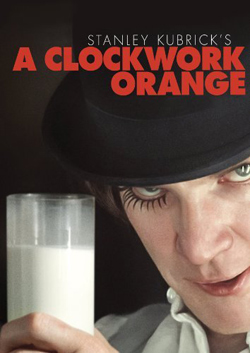
In this tale of free will and morality, Alex still stands out as the protagonist. He is certainly a criminal, but we cannot help but sympathize with him. He is pure at heart and certainly passionate, unlike every other character in the book. When the government uses experimental aversion treatments to make acting on his criminal impulses impossible they inadvertently take away his free will, which we find disgusting and immoral. But is this not what law and punishment does? Those criminals who cannot behave within our system will be imprisoned, revoking their free will. But what if we didn’t have a free will to retract in the first place?
I am not arguing to open up the prisons and let everyone run free. Obviously, that would be problematic. Our questionable lack of free will is a philosophical concept, one that should be applied empathetically as we look at the criminals and bad guys of both literature and reality. Understanding that criminals are made by their environment is a key concept when confronting crime and punishment. If this is true, early childhood education, morality, and improving communities are the tools to reversing the grips of criminality.
In the end, we might not have a choice in what decisions we make, but we most certainly have to deal with their consequences.
This Sweepstakes has ended. Check out current opportunites at our Sweepstakes feature page.
To enter for a chance to win one of three paperback copies of Virus Thirteen by Joshua Alan Parry, make sure you’re a registered member of the site, and then simply leave a comment below.
TIP: Since only comments from registered users will be tabulated, if your user name appears in red above your comment—STOP—go log in, then try commenting again. If your user name appears in black above your comment, You’re In!
NO PURCHASE NECESSARY TO ENTER OR WIN. A purchase does not improve your chances of winning. Sweepstakes open to legal residents of fifty (50) United States and the District of Columbia, who are 18 or older. To enter, fill out entry at https://www.criminalelement.com/blogs/2013/03/the-hot-tub-philosopher-on-crime-joshua-alan-parry beginning at 12:00 p.m. Eastern Time (ET) March 20, 2013. Sweepstakes ends at 11:59 a.m. ET on March 27, 2013 (the “Promotion Period”). Void outside of the 50 US and DC and where prohibited by law. Please see full details and official rules at https://www.criminalelement.com/page/official-rules-virus-thirteen-sweepstakes. Sponsor: Macmillan, 175 Fifth Ave., New York, NY 10010
Joshua Alan Parry is a medical resident at the Mayo Clinic. He received his medical degree from the University of Texas Medical School at Houston and holds a B.S. in molecular and cellular biology from the University of Texas at Austin, where he was also captain of the ice hockey team. Over the years, he has worked as a guide for at-risk youth in the Utah wilderness, a metal worker in Montreal, a salmon canner in Alaska, and a molecular genetics intern. He was raised in Keller, Texas.
Why do people commit crimes? I honestly think a Watergate era excuse is still relevent: “It seemed like a good idea at the time.”
Interesting post
Virus Thirteen sounds fascinating! I love a good medical thriller read.
Sounds great! I love reading thrillers and crimes.
thanks for this giveaway.I love thrillers.
Thank you for the great giveaway please count me in 🙂
looks great!
I like most mystery and suspence novels, but having studied to be a nurse
I especially like medical myseries. When winning a book by an author I have not read, gives me a chance to find out if I want to add them to my must have reading list.
Would love to read!!
This sounds awesome – sign me up!
Having been a teacher at all levels for all of my working life, I still like to think every person has a choice. But when I see the conditioning some of these kids are subject to in their formative years, I really begin to wonder. Perhaps we share a lot more with the rats in a maze than I think.
Hmmmm…morality…free will…guns and a hot tub.
Seems like an interesting book. Sign me up.
I am ashamed to say I have never read Clockwork Orange. I have no idea why not. 🙁 But I love medical thrillers, so Virus Thirteen sounds fascinating to me.
Love the hot tub photo–mostly the idea of relaxing with a glass of wine. Not so much the hardware!
Virus Thirteen sounds like a good medical mystery/thriller and I would get a chance to read a new author.
sounds like a good one!
Ooooooh Please… Give me thrills!!!!! Please and thank you 🙂
I believe we always have a choice in the decisions we make.
A book to make one think? Fabulous!!
Thank you,
Sounds intriguing!
What a awesome title! It sucks you right in!
Sounds like a good read. Thanks for the contest.
While I agree that improving early childhood education and community support for families would have a positive impact on crime rates, this argument totally ignores all the people who grew up in horrific circumstances but did NOT become criminals. There is more to being human than nature or nurture.
Looks interesting
Sounds like a great read.
Fascinating argument. But, for what’s it’s worth, I believe in free will. After all, many people are born into dysfunctional homes, but they don’t all choose to be criminals.
I would love to read “Virus Thirteen”!
theyyyguy@yahoo.com
I have to come down on the “free will” side of the arguement. We make choices all the time. Circumstances come up, but we still get to make choices. Criminals make bad choices, and most of them, as depicted, don’t change that until they are locked away or otherwise seperated from the common herd. Part of that is the idea of easy or hard choices, and most of us avoid the hard choice. Part of that is consequences, that we either don’t consider or look at through “rosey colored glasses”.
I hav never read one of his books but this one sounds good. I would love to try this one. I love medical thrillers.
sounds great
I love mysteries and thrillers, especially those which are medical as they really make you think about what could be.
Sounds like a great thriller. Hope I win
daveshir2005@yahoo.com
What an interesting discussion of the role of free will in criminal activity and society’s limits on its ability to understand and forgive crimes because of our own beliefs regarding free will. Great think piece!
If people believed in religion then they probably wouldn’t commit crimes…. But then I don’t know what makes people commit crimes either.
Thank you for the giveaway. This sounds like a wonderful read. On the subject of free will and crime, I will only say that there are many who are born into difficult circumstances who do not commit crimes and many who are born with the proverbial silver spoon who do commit crimes.
would love to give this book a try!
Interesting topic, free will? Evil or good, how we turn out. Really wold love to read. Thanks
looks great.
I love to read and I really want to read this!
SOUNDS LIKE GOOD READING
Looks cool.
Thanks for the sweepstakes.
Sounds interesting – count me in please
It sounds like a good read.
It sounds like a good read.
This book sounds good.
OOOH pick me.
a desperate terriost, armed goverment agents and a virus thirteen–all kinds of bad guys. book sounds great
I’ve known plenty of hot tub philosophers, but this is the only book by one I would want to read.
Sounds great.
I would love to win!
Sneaky indeed! Now why put a giveaway for a biotech thriller on a post about freewill? I am obviously not enough of a deep thinker to make the mental leap. However, being a passionate fan of books like this I can jump the chasm between my brain and my fingers (admittedly large) and post a comment for the opportunity to win an awesome book that would give me an excuse for insomnia.
choices,choices,choices, whos got a choice on this read, just got to have it