
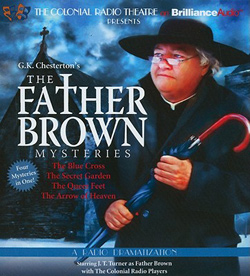
In “The Queer Feet,” one of the early stories, Chesterton refers to Father Brown as “a mild hard-working little priest.” And that is the image he continues to project. He often appears somewhat distracted and a little unfocused. He seems to prefer being in the background and going unnoticed, almost begging to be dismissed as irrelevant. He credits his unfailing ability to see through the worst behavior of the criminal mind to his many years in the confessional granting absolution for every imaginable sin, and confounds the criminals who cross his path by use of his unerring sense of human frailties. Witness his conversation in this video from the 1954 movie, Meet Father Brown, released in the United States as The Detective. And yes, that is Alec Guinness playing the role of the good Father.
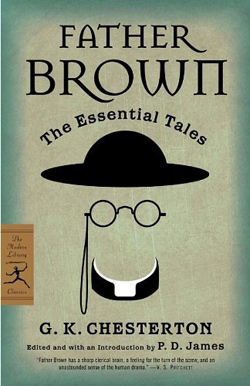
As P. D. James wrote in her Introduction to Father Brown, the Essential Tales, “We read the Father Brown stories for a variety pleasures, including their ingenuity, their wit and intelligence, and for the brilliance of the writing. But they provide more. Chesterton was concerned with the greatest of all problems, the vagaries of the human heart.” And Chesterton’s legion of fans keep him in their hearts through organizations like the American Chesterton Society.
And Father Brown does seem to have a profound religious effect on those who associate with him. Chesterton converted to Roman Catholicism in 1922 and much of his later non-fiction reflected his beliefs.
More dramatically, Alec Guinness was so taken with how people responded to him when he was wearing the frock required for his priestly role that he began stopping in Catholic chapels for prayers, particularly when a family illness caused much distress. He and his entire family subsequently converted to the Roman Catholic faith.
In addition to the religious sentiments, the Father Brown stories also have an old-fashioned feel when it comes to language and style of writing which are enjoyable and comforting. (And, not incidentally, remind us not to take offense at the ethnic references which are appropriate to the time in which the stories were written.)
So, tell me, have you ever read G. K. Chesterton’s stories about the pleasantly doddering Father Brown? And in the present mystery climate of blood, gore, and hi-tech, would you recommend him to a friend?
Terrie blogs at www.womenofmystery.net. One of her recent short stories can be found in the anthology Crimes By Moonlight and another can be read on the Beat To A Pulp website.
You’ve just added another name to my must-read list.
I help out with an Freshman English seminar on detective fiction. Last semester we added some Father Brown as a contrast with the methods of Sherlock Holmes. The students did think Father Brown a bit on the slow side but liked him enough for us keep him represented in the class.
Would I recommend him? Hmmm, depends. To a reader who like cosies or stories more in the classical detective period, sure. To someone interested in detective fiction from an academic standpoint, most certainly. I would need to know something about a person’s reading interests before I would blindly recommend Father Brown. Personally, I read noir/violent thrillers but enjoy these sorts of stories as well.
@Leslie. I’m sure you’ll enjoy Father Brown. @Mack. What a wonderful course! Father Brown is an excellent contrast to Sherlock Holmes and Father Brown was also the precursor of Miss Marple type amateur sleuths. and I agree, that these less violent stories make a nice change from noir and thriller.
I would (and do) always recommend Father Brown. I am a reader of classic (and New Orthodox) mysteries, and from my POV, Father Brown are simply a must -read. Chesterton’s writing is wonderful (Brown’s paradoxal utterances are fantastic!) on its own, but more importantly, many ‘cliched’ tricks and tropes of the genre originated in these stories and they are even now still seldom challenged, let alone surpassed.
Ho-Ling Wong, what is a New Orthodox mystery? It is a new term to me.
It’s a term used in Japan (shinhonkaku-ha, the new orthodox movement), used for a literary movement in mystery fiction in Japan since the ’80s. A revival of the classic mystery model in a modern setting (-> [url=http://www.criminalelement.com/blogs/2011/05/ellery-queen-is-alive-and-well-and-living-in-japan]see my article on it on the site[/url])
@Ho-LingWong, I remember that excellent article. In fact, I presently have The Tokyo Zodiac Murders on reserve at the library. Hope to get and read it before summer’s end.
Would I recommend Father Brown to a friend? I have – many times!
Excellent stories. The Father Brown tales are landmarks in the genre.
When I was a literature major in college my senior seminar paper was on Father Brown stories in The Scandal of Father Brown. The angle I took is that Chesterton used the structure of Biblical parables as a model for his Father Brown stories. I would’ve preferred a different book (The Incredulity of Father Brown where “The Oracle of Dog” first appeared is my favorite because of the numerous impossible crime stories), but I had to choose among the books the instructor had selected for the course. It’s still one of the best and most original pieces of criticism I ever wrote. Chesterton can be inspiring!
Ho-Ling is correct about Chesteron’s contributions to the genre. “The Invisible Man” is a brilliant story that contains a plot element that has been recycled many times and might now be considered one of those cliche tropes. To this day the term “the invisible man” alluded to a mystery novel is a nod to Chesterton and Father Brown.
Ah, Father Brown… G.K. Chesterton is one of my favorite detective-story writers, surpassed only by Agatha Christie and John Dickson Carr (in that order). His plots are fantastic, his characterizations well-done, and Father Brown is a brilliant parody of the traditional, Holmesian detective. The first story I ever read was “The Invisible Man,” which led me onto several others, and I eventually read the whole first collection, The Innocence of Father Brown. Chesterton is just a fine writer; someone else points out all the parodoxes he creates and that Fr. Brown cryptically utters. My favorite story is probably “The Eye of Apollo”–but all of them are fine.
J.N.
from [url=http://yetanothermysteryblog.wordpress.com][u]yetanothermysteryblog.wordpress.com[/u][/url]
John and J.N., I am so happy to know that there are so many Father Brown fans singing his praises. I’m glad you enjoyed this post and I thank you for your suggestions to other readers.
J.N. commented that Father Brown is a brilliant parody of Holmesian detectives. If anyone hasn’t read The Abeence of Mr. Glass then do so immediately. It is a delightful poke at The Great Detective.
Thanks, Mack. I’ll look it up.
Yes, John, and yes, J.N. I am overjoyed to learn that there are so many Father Brown acolytes out there singing his praises. I’m happy you found value in this article, and I appreciate your feedback.
Your blog gave us useful information that we can use. All of the tips in your post are great. Many thanks for giving. Keep blogging
We can provide all the assistance you need to set up your business in Mauritius in accordance with the Business Registration Act so that you can focus on your prime goals and let us handle the rest.
Commercial CCTV installation is becoming increasingly popular in the business world. Not only does it provide a sense of security to the premises, but it also allows businesses to monitor and protect their assets.