
 I'm one of the very few Sherlockians I know possessed of a rabid aversion to deerstalkers. When I think about the iconic chapeau of our personal hero, I get an expression on my face not dissimilar to Keith Olbermann's moments before the glasses are torn off and Camera Three gets a wet lensful of disdain.
There are only two good reasons for this quirk, really. First, the deerstalker was a spring-in-the-countryside sort of accessory, the kind that required a rifle and muddy tweeds and a spaniel called Byron or Lulu, and they are tragically overused by peddlers of Sherlock Holmes-related culture and paraphernalia, and the proper use of fashionable accessories is a practice very dear to my heart. And second, I was born right around when AC/DC was busy releasing Back in Black, which means that “my” Sherlock Holmes was never going to be Christopher Plummer in Murder By Decree, leaving the opera wearing a. . .a thing on his head resembling a sordid affair between a pancake and a tartan skirt. I've never sat through an entire Basil Rathbone film, because the instant poor Nigel Bruce opens his mouth, I start seething. Jeremy Brett, he of the Sidney Paget-appropriate sartorial choices, undeniable theatrical talent, and slightly overcaffeinated facial expressions, came within a close shave.
And now there is Benedict Cumberbatch swanning ferociously about in a Belstaff coat and wine-colored dress shirts, and the Holmes in my head is alive and well and living in London.
The notion of transplanting Holmes and Watson to the here-and-now of modern London frankly could have gone very south, very fast. Thankfully, co-creators Steven Moffat and Mark Gatiss have brought to the screen an alternate universe at once accessible to non-Sherlockians and rife with clever, apt references for insiders. Said Moffat of the dangers of updating the original stories, “. . .Frankly, to hell with the crinoline. Other detectives have cases, Sherlock Holmes has adventures, and that's what matters.” A truer sentiment I've never heard.
And nary a deerstalker in sight.
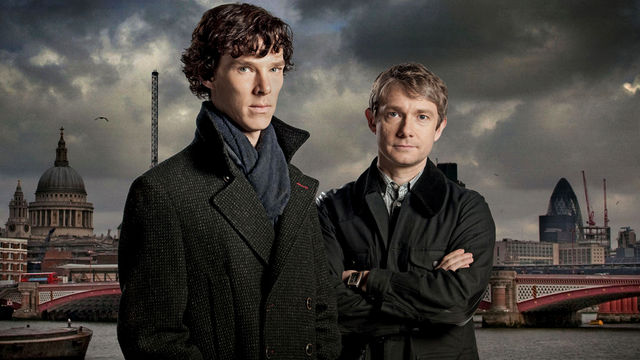
When initially convinced that the string of suicides being investigated by Lestrade are in fact the work of a serial killer, his gleeful, “I love those,” is both callous and boyish—a much more evocative reading of Sherlock Holmes at the beginning of his career (canonically, he was twenty-seven when he met John Watson) than I've ever before seen. While a feeling and accurate portrayal, Brett had passed his fiftieth year before embarking on the Granada Holmes series, and seeing Sherlock Holmes in the early days of a brilliant invented career is exhilarating to anyone who naturally roots for the heroic outsider. Not to mention, watching him spear his correspondence to the mantelpiece with a penknife ignites the fluttery heart of the true Holmes fan like Jack Nicholson at a Laker game.
Martin Freeman's John Watson is likewise both entirely the Watson of the canon and a present-day veteran haunted by visions of the Afghan War (the fact that BBC's Sherlock is required to ask “Afghanistan or Iraq?” rather than stating the infamous “You have been in Afghanistan, I perceive,” is at once painful social commentary while being deliciously topical). Watson's oblique references in A Study in Scarlet to restlessness, sleep disorders, and trouble with his “nerves,” are here presented as entirely natural post-traumatic stress disorder, for which John has been given a cane for phantom leg pain and a therapist whose healing efforts are barely tolerated.
John is a soldier, a man of action, and here in London, nothing ever happens to him. He suffers equally from the nightmare of recalled combat and the tediousness of living an unmoored, purposeless existence on a slim army pension in a city too vast and anonymous to feel like a home. Enter Sherlock, razor-eyed and maniacally focused, who can tell John's entire life history from his mobile phone (the relevant deductions are based wholly on a passage from Doyle's second Holmes novel, The Sign of Four). John needs a cause. Sherlock, it becomes increasingly clear, needs a conscience.
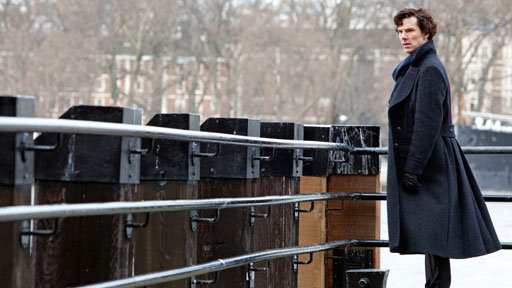
And three episodes, fans of the series agree, are not nearly enough.
I'm beginning to think that my aversion to deerstalkers is due as much to senseless insistence on the non-canonical prop as any aesthetic concerns (notwithstanding the fact that avoiding a Droopy Dog profile whilst wearing one is a herculean act). Moffat and Gatiss have created a world in which the trappings endemic to Sherlock Holmes are only retained if they are both relevant and character-enhancing, rather than simply expected. The results have generated widespread Sherlockian praise, admiring critical reception, and one of the swiftest-formed and most active internet fandoms in recent memory. Personally, the effort of keeping calm while new episodes are produced is wearing heavily on my mental health. Reviewing existing episodes will be, I hope, a palliative, if not a cure. Stay tuned for thoughts on “The Blind Banker,” or “Why Fu Manchu Tropes Ought to Fade Peacefully Into That Long Goodnight…”
Lyndsay Faye, author of Dust and Shadow and The Gods of Gotham, coming Winter 2012 from Amy Einhorn Books/Putnam. She tweets @ LyndsayFaye.
You have me convinced, I will check this modern Holmes out. I’m a purist by heart and prefer the Victorian era. But the trailer and your review has me wanting more. Thanks.
I adore the new Holmes, but then I like the old Holmes and even the movie Holmes-as-action-hero. (The various “young Sherlock Holmes” type tv things didn’t impress me, however.) I was so frustrated to be left hanging at the end of the three episodes…I can’t wait to see what they come up with next!
I am also a fan, and also NOT a fan of the deerstalker; I read the books, but never got into any version on film–until this one. So happy the series is returning.
I really enjoyed the three episodes; I’m so glad to hear that there are more coming!
The Moffat quote re: adventures/cases is spot-on. I hadn’t heard that before, but he’s absolutely right. And now that I think on it, a number of my favorite mystery stories (Holmes or otherwise) were explicitly “Adventure of…”
One of the best things on British TV last year – I was disappointed that there were only three episodes to start with, too, but Stephen Moffat was rather busy with Doctor Who at the same time. I’m looking forward to more (and isn’t Benedict Cumberbatch dishy?)
My deerstalker never fit anyway……..
Good stuff.
I’ve been hearing great things about the young new Holmes. You’ve convinced me. I must watch for myself.
A different Twist? Must watch for me…..Now to Locate it on my Comcast Channels….
Those three shows really were wonderful. This Sherlock is still not the one I have in my head, but I love the age appropriateness, canonicity of the scripts, adventure, and (if you are a Sherlockian) the inside jokes. I don’t hate deerstalkers as you do and give them more canonical appropriateness than you, but seldom has anyone seen me in one. I wonder if it made people who wear them feel silly back in 1895. I was disappointed by the ending of the third episode of Sherlock. (I won’t divulge it.) I found it completely unnecessary and contrived.
Glad you’re doing this.
Nice piece. I caught the debut episode and really enjoyed it, but I haven’t gotten around to the rest of the series yet. This post certainly prompts a return to the series, so thanks!
I loved the new Holmes and modern Watson. I think they kept the ideal character traits that made Holmes “Holmes” and Watson “Watson”. Its well written and cast. I will watch any new episodes BBC airs!
I’m partial to Jeremy Brett as Sherlock Holmes, but I do love the new Sherlock with Benedict Cumberbatch and Martin Freeman. The crisp pacing and sharp dialog we cherish in Doctor Who thrive in this series. Every Doctor Who fan should investigate Sherlock.
I’m glad you folks are giving the BBC version a shot! It tickles me greatly. Their adaptation is just so much edgier, in a good way, than any I’ve ever seen. And let’s face it, Sherlock is an edgy hero. He’s not Superman, he’s Batman. This is one of very few versions that is appropriately dark, wry, and funny.
Thnaks for Shaering it