
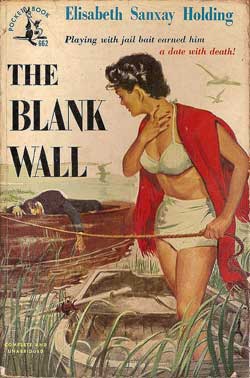
 If you trace the roots of literary noir back far enough, eventually you’ll run into the unlikely figure of Elisabeth Sanxay Holding. Though in recent years she has been overlooked in the rush to canonize folks such as James M. Cain and Cornell Woolrich, Holding was just as pivotal in the development of noir as a distinct literary genre. Like Cain and Woolrich, she didn’t write about hardnosed good guys very much. Before the term “roman noir” had even been coined, her specialty was isolated and desperate characters with profoundly poor decision-making skills.
In her time, Holding sold well and was highly regarded by her peers. No less an authority than Raymond Chandler called her “the top suspense writer of them all.” The critic Christopher Morley wrote of one of her books, “This is the kind of thing I recommend to a few like myself who find the purest refreshment in hallucinations and horrors, in damnation, dipsomania, and dismay.” And looking back on her career, the great Anthony Boucher (namesake of the Bouchercon World Mystery Convention) noted, “Before anybody had ever heard of ‘pyschological novels of suspense’ Elisabeth Sanxay Holding was writing them, and brilliantly.”
So why has she been largely forgotten today?
Well, for one thing, she struck a decidedly matriarchal figure. Born in Brooklyn in 1889, she married a British government officer named George E. Holding in 1913, she gave birth to a daughter and son and traveled around the world with her husband. Something about Holding’s life smacks, on first glance, of the cozy English mystery tradition.
Secondly, she was a woman in a distinctly masculine field—and she wasn’t a hard-living broad like Patricia Highsmith, either. She was a lady, educated at Miss Botsford’s School and Miss Whitcomb's, and a government official’s wife. By the time “noir” became a term critics were tossing around, she was a plump grandmother in her sixties.
None of that matters, though. I’d wager everything I own in the world that if you could have sidled up to Holding at some stuffy dinner party and asked her what she was really thinking the answer would have been darkly funny and perceptive.
Her books remain impressive today. Her best, undoubtedly, is the masterpiece The Blank Wall (1947). The book tells the story of Lucia Holley, a married mother of two living in a quiet coastal town in California. Without telling anyone where she’s going, one day Lucia drives the family station wagon to a cheap hotel in town to see a man named Ted Darby. He’s a shady character, all sleazy charm and insinuations, who has being seeing Lucia’s teenaged daughter, Bee. Lucia wants him to stay away from her daughter, so Darby smiles and suggests that he might be open to a little monetary persuasion. Lucia throws his offer back in his face, confident that when she tells Bee about Darby’s offer, the girl will end the relationship herself.
When Lucia discovers Darby’s dead body the next morning, however, The Blank Wall becomes truly fascinating. Lucia disposes of the corpse, unsure exactly what has transpired, but suspecting that she is covering up a murder. Once the body is found by the police, Lucia is the only one who knows what happened—up to a point, because even she doesn’t know exactly what happened. Things get worse with the arrival of a hood named Donnelly who has some love letters written by Bee to Darby. He wants cash or the letters will go to the police.
The Blank Wall is a fascinating piece of work, the story of a woman desperately trying to hold her life together and protect her child in the face of almost certain doom. The book demonstrates Holding’s great gift as a writer, a precise emphasis on the inner life of her characters. Lucia Holley doesn’t stop being Lucia Holley after the dead body shows up. She has to tend to her children, run her house, take care of an elderly parent, pine for her absent husband—all the while trying to negotiate with blackmailers and dodge the cops who are looking into the Darby murder.
The book aptly demonstrates a favorite Holding theme, the crushing weight of familial obligation. I have no sense whatsoever of what life in the Holding household was like, but family life in her books is pretty much a form of social suicide; characters are trapped by family life, surrounded but alienated at the same time.
Net Of Cobwebs (1945) tells a truly bizarre tale of a war vet with shaky nerves who becomes convinced that he’s murdered his domineering elderly aunt. The book has, in some ways, the structure of a parlor room mystery story, but one written by, say, David Goodis at his most insane. “What had he got into,” the narrator asks at one point, “what dim little hell?”
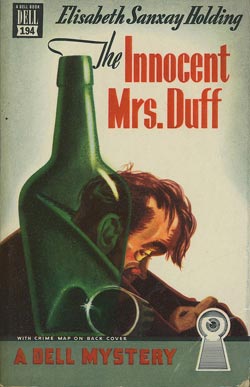 Some of her work reads as if it could have given birth to Jim Thompson’s unhinged psychos. Take her wonderfully acidic The Innocent Mrs. Duff. Like much of her work, it assumes the perspective of a hateful alcoholic with a gut full of whiskey and head full of bad ideas. Jacob Duff is a drunken son of bitch who is getting tired of his much younger trophy wife. He concocts a plan to run her off by framing her for adultery, but when it doesn’t work he starts hatching plans to get rid of her permanently.
You want to see how a great writer portrays the mind of a thoroughly repellant human being? Check out what Holding does with Jacob Duff. “He glanced at her across the table,” she writes of their breakfast one morning. “She’s beautiful, he thought with distaste.” In Jacob Duff’s mind his wife’s beauty has become grotesque. Again, we find domestic life rendered as a kind of living hell. “If I could be free,” Duff thinks at one point, “if I could get out of this situation and start over again I'd do very differently. None of this damn suburban life. None of this slavery.”
If you want to deepen your understanding of noir’s roots—and if you want to read some crackerjack storytelling along the way—find your way to Elisabeth Sanxay Holding. The godmother of noir awaits you.
Essential Holding
1. The Blank Wall—Goes up there on the list of classics alongside The Postman Always Rings Twice, The Maltese Falcon, The Long Goodbye, and A Hell Of A Woman. Also do not miss either of the excellent films that have been made from this book, 1949’s The Reckless Moment starring Joan Bennett and 2001’s The Deep End starring Tilda Swinton.
2. The Innocent Mrs. Duff—I meant the Jim Thompson comparison above.
3. Net Of Cobwebs—Trippy to the point of surrealism. But with golden lines, as when one character starts to justify her terrible actions and the narrator jumps in to observe “For who has ever looked into his own soul and condemned himself unreservedly?” That right there just about sums up noir.
4. Dark Power—Think your family is bad? Diana Leonard has a manipulative, nutjob psychologist for an aunt, a sadistic weirdo for an uncle, and a self-hating drunk for a cousin. Part mystery, part gothic horror novel, Dark Power is Holding at her nightmarish best.
Jake Hinkson, the Night Editor, is the author of The Posthumous Man.
Read all posts by Jake Hinkson for Criminal Element.
I [b]need[/b] to read these. Thank you, I knew nothing about her until this post!
I’m gad to make the introduction! I bet you’ll dig her. THE BLANK WALL and THE INNOCENT MRS. DUFF are the place to start.
Also, Stark House has put out some nice [url=http://www.starkhousepress.com/holding.php]2-for-1 editions [/url]of her books.
I was just mentioning what an excellent, tense film The Deep End was, and now I know the source material must be even better. Thanks for the tip, Jake!
These books sound great. Never had heard of her but can’t wait to read her now. I saw both The Reckless Moment and The Deep End and it’s something to hear she wrote the novel they’re based on. Both movies were good.
Thank you so much for this post!
I have a new role model. Thank you.
I’d add The Death Wish and Unfinished Crime to the best of Holding. The first tells a story of marital blues and murderous fantasies that turn deadly all the while commenting on the already boring suburban dream of America. Yes, the routine of suburban life was driving people to murder as early as 1935. The second is probaby the earliest book she wrote to comes closest to foreshadowing the kind of book that would soon be the hallmark of Patricia Highsmith. Holding did it decades before her.
It’s always interesting to me that reviewers have to draw comparisons to male writers when talking about Holding. Is it to make her more attractive to male readers? I find her work to be closer to Margaret Millar, Charlotte Armstrong and Dorothy B Hughes who are also underclassed , underappreciated, and hardly read by most of the people who think they know the best of dark crime fiction. And I don’t this has anything to do with their homelife, their looks or the fact they are writing in a “distinctly masculine field”, the least accurate statement you attribute to Holding’s status as a forgotten writer. I think it has more to do with publishing houses not recognizing quality and keeping these women’s books in print.
@ J F Norris The organization Sisters in Crime was founded by crime-writing women,decades after Holding, because they realized not only that women writers got reviewed much less often, but that there were male readers who wouldn’t even try reading them–such that the previous Charlottes and Dorothys had become mere C.s and D.s to try not to discourage sales. It wasn’t only the publishing houses or even the industry, but culture more generally that didn’t always give these women enough chance to find their readers. (Which makes me wonder, because I can’t think of any–were there any women writing pulp westerns at all, even under pseudonym?) It’s an undeniable shame, but it gives some of us a lot of great work to (re) discover now.
Elisabeth Sanxay Holding was very well reviewed by male reviewers and was a successful popular writer who presumably was read by men as well as women.
John Norris is right that saying she wrote in a “distinctly masculine field” is just dead wrong. Jake Hinkson himself probably realizes this now that Sarah Weinman’s anthology of these women writers has appeared. And Holding herself has been reprinted over the last decade by Stark House, so don’t blame all the publishers. Small publishers have done right by a lot “forgotten” writers and people should make more effort to seek them out.
I don’t know that I would blame “culture” so much as the prominent canon-makers, who, for whatever reasons, ignored a lot of these writers.
Why do you say The Blank Wall is set in California? I was trying to decide if the location was Long Island or Connecticut.
The novel “The Blank Wall” takes place near New York City, I think it’s mostly set on Long Island even though CT is mentioned as well.
The movie “Reckless Moment” (1949, James Mason as Donnelly, Joan Bennett as Lucia) was filmed near Balboa Island, CA. Check it out in the imdb.
BF
Don’t know her, but glad to now! 😎