
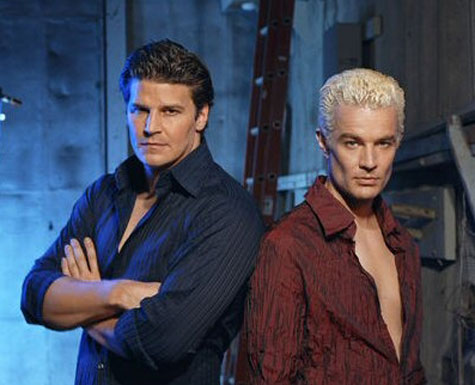
I’m sure this title makes no sense to those souls who have never watched Buffy the Vampire Slayer, which aired on TV from 1996 to 2003. In fact, the names of the two most important male characters would seem to indicate that Spike, whose name sounds like a street tough, is the villain, and Angel, whose name sounds, well, angelic, is the hero.
Well, that’s partly true. Angel, the reformed vampire with a soul, is the hero and romantic lead, a tortured Heathcliffesque character who broods about his evil past. And Spike? Well, “reform” is not a word one thinks of in connection to Spike. But he is definitely my favorite and, in my very informal survey, Spike, the vampire who goes from evil to good and back again—and is frequently both at the same time—is by far the more popular. Spike, in fact, became one of the most popular characters on the show and a cult favorite.
Why is this? Shouldn’t Angel, the brooding vamp who will lose his soul if he experiences true happiness, be the most popular? Spike, after all, is evil. Even when he becomes, well, not good exactly, but less evil, and attains his heart’s desire—Buffy—he remains a bad boy. Is he popular because he is the bad boy, the antihero? Partly. Is it because of the appeal of James Marsters and those killer cheekbones? Again, partly. But for me his appeal is more nuanced than that.
The Buffy world begins in high school and, to some degree, that dynamic continues throughout the show. Buffy is the prom queen and Angel is king. Cordelia serves as the envious, less popular girl, wanting to take Buffy’s place. In fact, they compete for the title of homecoming queen in the larger high school world. Spike fills the same role as foil to Angel. Certainly Spike plays the role of second banana when he is a member of Angel’s vamp group.
But as the show moves forward, Spike evolves into a more complicated character. As early as 1998, Spike, still an evil force, allies himself with Buffy to save the world. Angel, who has lost his soul with the consummation of his love for Buffy, is trying to raise a demon to destroy everything. Spike’s flash of altruism is explained by his self-interest; he doesn’t want the world destroyed. And his very unexpected truce with the Slayer foreshadows his future, as a semi-regular member of the Gang. And a character who is capable of great evil and great good.
He never becomes a replacement for Angel, even when David Boreanz (who plays Angel) leaves the show. Spike becomes the romantic lead and, arguably, the most important male character in the Buffy world. But he is not the prom king. No one in the gang, not even Buffy, ever trusts him completely, and with good reason. Spike does what he wants. He wants to be good but he enjoys being a bad boy too much. He may be fighting an evil vampire one second and making a deal with a demon the next. He is always himself.
Look at the relationships the romantic leads have with Buffy. Angel’s love for her almost costs him his soul. And Riley turns to the vampire junkies, because they need something from him; Buffy doesn’t. Spike tries to change, over and over, but doesn’t succeed. Although his love for Buffy endures, he remains Spike, flawed and fascinating.
Transformed to a vampire, he becomes part of Angel’s coven, and for the first time, he becomes part of something. He has his own little family and is too scary to be mocked. Recalling his experiences with Angel and Drusilla during the Russian Revolution, Spike tells Buffy that it was the best time of his life. His wistful regret for a happy time that has passed really resonated with me. He is never really happy again.
Angel, on the other hand, never worries about fitting in. Why should he? He is always the leader. As a vampire, he has a rep as the baddest of the bad, with no pity or remorse. But when he reforms, he reforms all the way, becoming, to my way of thinking, a little self-righteous. He strides through the episodes like Cotton Mather in a leather coat. Yet, when he loses his soul, he becomes über evil. There are no gray areas with Angel.
Spike is a mosaic of gray. He certainly never achieves Angel’s almost arrogant level of self-confidence. In fact Spike remains always insecure, a feeling he covers with a flippant swagger. He wants someone to love him, first Drusilla and then Buffy, but never succeeds in attaining the relationship he wants. He wants to fit in but he just can’t manage it. Not and stay who he is. He wants to be good but only sometimes and not yet. Totally understandable.
Buffy the Vampire Slayer is a multi-layered show with many strands that explain its popularity and its following even now. And Spike is certainly a big part of it. He is villain, hero, and antihero all at once. In the final episode, Angel expects to save the world by sacrificing his life. After all, he is the hero and the good vampire. But it is Spike, the very flawed character whose journey we have shared, who is chosen. And that feels right.
Eleanor Kuhns is the 2011 winner of the Mystery Writers of America/Minotaur Books First Crime Novel Competition. A career librarian, her second novel, Death of a Dyer, will be out in 2013. She lives in New York.
I totally agree with you. Count me in Spike’s camp. Angel was too self-righteous, self-involved, and broody. I even wrote a series of poems, published in my second book of poetry, that were based on Spike’s character as the archetype of the “bad boy.”
“the hero and romantic lead, a tortured Heathcliffesque character who broods about his evil past.”
Based on this, I’m betting you’ve never read Wuthering Heights.
While I really like your description of Spike, who’s my favorite character in Buffyverse besides Buffy, your descrption of Angel is oversimplified, full of cliched and very off. Angel never worries about fitting in? Angel worries about fitting in all the time. His entire unlife since being cursed with a soul is a story about not fitting, since the time Darla threw him out when she realized he had a soul, and when he didn’t manage to convince her he was still evil, even though he tried hard, because he didn’t want to be cast out and left alone. He’s always trapped between the worlds and never feels he can be either human or proper vampire. Angel is the “prom king”? In what universe? On BtVS, which is what you’re writing about here, Angel is a mysterious outsider who skirts on the edges of Buffy’s life and attracts her exactly because of his outsider status. And for that matter, in that universe is BtVS Buffy “the prom queen”? She lost the chance of being that when she became a Slayer, and it made her one of the outsiders and “freaks” and the people in school thought she was crazy. This is why the two of them were drawn together in the first place: she’s human but she can’t be normal; Angel was a vampire with a soul, who couldn’t live in the vampire world or in the human world. Neither of them fully belonged anywhere.
But SHE was a leader and a hero. She was the Slayer. She had school and she had her friends and her mother. Meanwhile, Angel, while on BtVS, was just her love interest/boyfriend, when he didn’t lose his soul and become a villain. Soulless and evil, he used to be a leader (partly; he was no leader of Darla). With a soul, he spent most of the last hundred of years wandering around, staying in LA hotels and getting lynched by the mob, or sleeping in the street eating rats, which is where Whistler found him in 1998. On BtVS, Angel with a soul was leader of nobody. He had no friends of his own, he was never really a part of the Scoobies, he had no job, and his only purpose was to follow Buffy around and help her, first with cryptic messages, later more directly. But this made him no more of “the hero” than Xander or Willow or Giles or Oz were; they were all helping Buffy. He did help save her occasionally, but less so than Xander, who saved Buffy’s life directly two times, one time in a really big way; and usually it was Buffy who got to save Angel (just as she was usually the one to save everyone). His most memorable and epic moment on BtVS was getting pierced with a sword and sent to Hell while having no clue what was going on – and this moment was all about Buffy, not Angel. One may say that, while on BtVS, Angel was mostly playing the male version of the “femme fatale” role to Buffy’s hero.
Angel had to leave Sunnydale and Buffy, move to LA, get a job and his own circle of friends/associates in order to become a leader. And to get some real character development and exploration. And it’s only when he got out of Buffy’s reach and shadow that he became a hero – something that Spike did not have to do. Although Spike had some of the same “homme fatale” role as Angel, Spike got ample character development, a lot of his own POV, a character arc, and a hero role on BtVS, while still being in (various kinds of evolving) relationship with Buffy; some even think he overshadowed her at times.
And then there’s the story of Angel the Series, where Angel finally did become the lead and the leader and the hero and got a lot of character development and exploration. But his own show – from season 2 onwards – also showed that Angel, perhaps more than Spike, is the ultimate antihero of Buffyverse, a monster-man who tries to be a hero all the time but, even with a soul, is constantly haunted by his own darkness that makes him do morally ambiguous and questionable things even when he’s trying to do good. Was Angel a hero at the end of his show? The jury is still out on this one.
I really enjoyed your Angel profile, it’s 2022 and I rewatched both series again during the COVID lockdown days. I found myself thinking of Buffy’s Angel as much more interesting with depth of character– just because I gave him credit for all of his character development in Angel’s Angel. My issue was that I never felt any electricity between Buffy & Angel. It was scripted, but it’s hard to make ancient, brooding & tortured spark with teen-queen-suddenly-slayer Buffy. Spike was my anti-hero because he made “less evil” look so good. James Marsters as Spike was one of the great casting choices of the decade. I BELIEVED he was a vampire who was attracted/addicted to the slayer. Spike was definitely a hero at the end of his show.
[color=rgb(0, 0, 0)] [/color][b]Is he popular because he is the bad boy, the antihero? Partly. Is it because of the appeal of James Marsters and those killer cheekbones? Again, partly. But for me his appeal is more nuanced than that.[/b]
[color=rgb(0, 0, 0)] [/color]Spike becomes such a great character and the most popular male character because of his journey of transformation. There is no denying that James Marsters is one of the primary reasons that Spike became, IMO, equal to Buffy in the powerful dramatic leads. James Marsters brought Spike to life with his superb performance and interpretation of the character, but it always comes back to Spike’s story and the transformation journey.
[color=rgb(0, 0, 0)] [/color]What would Spike have become in the series if he had remained in his original Evil Vamp/Bad Boy persona? Would he have ever reached the level of popularity and significance in series? My answer in a great big NO. Spike would have had his brief moment of the Big Bad and passed off into the land of great monster of the week land.
[color=rgb(0, 0, 0)] [/color]As for Spike becoming the Hero and ultimately transformed from his evil vamp/bad boy status – “Chosen” and “Destiny” must surely be the episodes that show us the fully transformed Spike. Both physically and in metaphor/symbols Spike passed through the trials and fires of creation/transformation and left behind his evil Spike life.
[color=rgb(0, 0, 0)] [/color]Spike may have once said to Buffy:
[color=rgb(0, 0, 0)] [/color][b]Recalling his experiences with Angel and Drusilla during the Russian Revolution, Spike tells Buffy that it was the best time of his life. His wistful regret for a happy time that has passed really resonated with me. He is never really happy again[/b].
[color=rgb(0, 0, 0)] [/color]But to counter this he reveals in complete honestly to Buffy that his night with her, just holding her and being close to her was “the best time of my life” and he also reveals that he has never been close to anyone in his entire existence. The only person that we ever see that loved Spike completely was his mother when he was William.
Clearly we are all Buffyverse fans. Thanks for your comments. You’ve given me a lot to ponder.
I totally agree with you, in my opinión Spike will always be the best character and in the end the real person who Buffy needs, we can see that in the last episode when she asked Angel to leave but she asked Spike to stay because she as she said she wasnt ready to be without him. Besides Angel gave up, he left her and has others relathionships, Spike stay with her until the end, even when she was death he looked after her sister and her friends, and he became a better man for her. Spike in the last season was much better than Angel. Spike without soul still lovef Buffy but Angel with no soul just wanted to maleta her suffer. Spike will always be the best one
I totally agree with you, in my opinión Spike will always be the best character and in the end the real person who Buffy needs, we can see that in the last episode when she asked Angel to leave but she asked Spike to stay because she as she said she wasnt ready to be without him. Besides Angel gave up, he left her and has others relathionships, Spike stay with her until the end, even when she was death he looked after her sister and her friends, and he became a better man for her. Spike in the last season was much better than Angel. Spike without soul still lovef Buffy but Angel with no soul just wanted to maleta her suffer. Spike will always be the best one
Spike and Buffy were one of the best tv couples ever. He stayed with her all the time, he protected Dawn, he changed for her and he died for her. Angel was just one high school love who just gave up and left her alone with all her problems, he was better with Cordelia. I will never understand who anyone could prefer that couple. Spike was the best couple, vampire and character
Even though I think Angel was more “right” for Buffy (in the sense that her and Spike would have never worked out, the level of admiration wasn’t equal) I’ve always wondered why Angel was on such a pedestal. When you start really watching, really thinking, he’s actually a fairly shitty person. He was a drunk, sloppy rich boy before he got turned into a vampire. Then he got turned into a vampire and he became the most cruel and sadistic one in history (supposedly). He then got his soul SHOVED back into his body. He started doing good deeds only to deal with his own remorse – to be liberated himself. He then started believing his good deeds to a point of self-righteousness, where he felt justified trying to revenge-kill WITH SOUL AND ALL Wesley after a terrible but honest mistake… I mean let it register for a moment: Angel, with soul, is capable of murdering someone he was very close to. Sadly parents lose children all the time, none of them feel justified to go on a killing spree – but Angel started believing that because he was being a “hero” he was above good and evil. Nobody even seems to mind any of this, he is surrounded by people who don’t just support him but actually feed his self-pity. No matter how many times his soul is reinstated/taken, Angelus never changes and remains evil as always. Spike was a decent person before he got turned into a vampire, his evil acts as a vampire were mainly to impress Dru and not out of sadism, he ASKED for his soul back and prior to getting said soul back even felt a level of remorse about assaulting Buffy. I mean come on. It’s not even close. Angel’s kind of an asshole… Spike’s kind of, well, not.
Spike’s ‘bad boy’ is ultimately not very impressive. How much tangible evil did he actually get done? Well, there’s the attempted rape…and that’s about it. What has Angel gotten done, as far as tangible darkness? Not counting Angelus, we have letting Darla and Dru munch lawyers, firing his team, boinking Darla with intent to become Angelus once more, Nearly strangling Wesley as mentioned above for giving Connor to an enemy, working with Wolfram and Hart to accomplish nefarious deeds as a plan to get into the Circle of the Black Thorn, killing Drogyn the Battlebrand without a second thought to get into the circle of the black thorn…very end justifies the means here…and then in the comics, we have the Season 8 ‘Twilight’ arc, where 14 million civilians, 206 Slayers, and Rupert Giles all die, the last snapped by Angel’s own hands before Buffy’s eyes. This also leads to the destruction of the seed of magic, which depowers all witches including Willow, and also breaks creativity itself, so that nothing truly NEW can be made. Why did all those things happen? Twilight promised Angel he could be with Buffy again if he signed up for that…and indeed he was, with some outer space sex. But the cost is greater than Angelus ever was. And so, you claim Spike was the bad boy. …That is not the case. He’s actually the good boy, no matter how he tries to fight it. The real darkness, the real ‘bad’…lies in the other vampire, who can not only do all of the above, but gets even worse if he experiences even a single moment of happiness. Angelus, the great Scourge of Europe, certified by the Judge to be humanity free and incapable of humanity in any respect, remains a rock star of evil, and sought after by virtually every evil organization on the show, from the Master, Darla&Dru, The First Evil, the Mayor, Wolfram and Hart, Twilight…the list goes on. And despite all that, you call Spike the ‘bad boy?’ No. He just isn’t. He’s really not. It is Angel who is Anakin Skywalker with Darth Vader just a moment of happiness away.
I don’t see Buffy and Angel as the prom queen/king at all either, except of course in their physical appearance. I think a major theme of the Buffyverse is alienation. Buffy just wants to be like “other girls in this glittering world” (to paraphrase what she sang in OMWF) but she can’t be because she isn’t like other girls. Angel is even more marginalized than that. I agree with a commenter here who suggests that he remains so until he leaves the universe in which Buffy is the sun and creates his own in L.A. where he can be the (somewhat darker) star at the center. That may be why I like Angel better once he leaves Sunnydale; he gets to be himself more. As for Spike, ah beloved Spike, it’s probably not fair to the character Angel that Joss perfected the glorious mess of a morally ambiguous vampire the second time around. Angel/Angelus was too black and white and I think they did a better job of graying his character in his own series. But Spike, beautiful Spike, is Birthed of good writing and a near-perfect performance by an actor (even his dodgy accent works because it underscores the performative armor Spike wears), Spike seduced so many of us, including Joss who I’m pretty sure loves him best of all his children (he’s hinted at it enough) even if he can’t come right out and say it. A lot of people hate that he, too, got a soul because that was Angel’s thing. He was so interesting without one because he did the right thing at times even when there was nothing in it for him – like continuing to be there for Dawn when, as far as he knew, Buffy was dead and buried forever. But then he’d turn around and bollox it up again! And, either way, he was entertaining, endearing and, of course, hot AF. 😉