
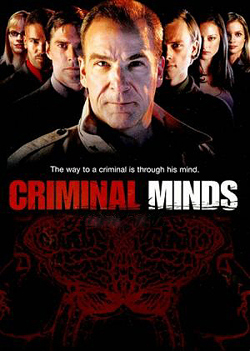
So in most stories we’ll have a cast of remarkable (or even unremarkable) innocents; people who are just going about their business until life suddenly goes off the rails because someone has colored outside the lines – aggressively.
If nearly every fiction has a crime, and every crime has its criminal, then by the transitive property, criminals are the hingepins of storytelling.
And as art most surely imitates life, there is a very real, but blurry place where facts are honed by fiction and fiction helps makes sense of the facts – Criminal Profiling, or by its more neutral new tag, Offender Profiling.
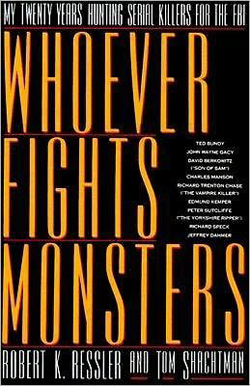
Whoever Fights Monsters is utterly riveting, and endlessly disturbing.
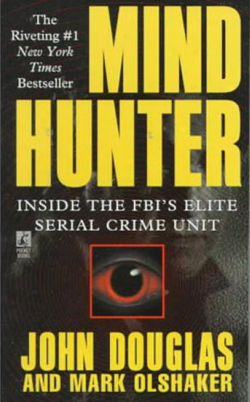
These two books became the yardstick for how I measured all subsequent crime fiction – hardback, paperback, small screen, silver screen. These men and their colleagues studied where they could, then reached past the end of what was certain to make fiction a tool to get to the truth. They weren’t the first of their kind, but the alchemy of right time and right place made their experiences and their ability to explain them a platform for laymen to appreciate. For me, it was no longer any good to tell me that something happened, then the next thing happened, then a car chase, a foot race, bang, bang, “You have the right to remain silent…,” The End. You had to tell me why, or at least try to make me understand. If thoughtful guessing was good enough for the FBI (and sometimes even producing results) then it was how it should be done.
For me and for many, from then on, the mysteries of law enforcement’s softer sciences have had almost a talismanic effect. If we can categorize and label what is in us and not in them (or vice versa) maybe we’ll be safe. Or safe-ish. What we know now, or at least think we know (or what we’ll admit is just our best guess at the moment) helps us construct a largely fictional why to what the physical evidence reveals about crimes.
Forensic psychology, statement analysis, and the dissection of body language for micro-expressions are all fictions of a sort. The Internet and your local bookstore can make you if not an expert, then at least a thoughtful customer and critic. My suggestion, though, is that you start with Messieurs Ressler and Douglas.
This sweepstakes has ended. For current opportunities, check our Sweepstakes feature page.
To enter for a chance to win one of three hardcover copies of Three Graves Full by Jamie Mason, make sure you’re a registered member of the site, and then simply leave a comment below.
TIP: Since only comments from registered users will be tabulated, if your user name appears in red above your comment—STOP—go log in, then try commenting again. If your user name appears in black above your comment, You’re In!
NO PURCHASE NECESSARY TO ENTER OR WIN. A purchase does not improve your chances of winning. Sweepstakes open to legal residents of fifty (50) United States and the District of Columbia, who are 18 or older. To enter, fill out entry at https://www.criminalelement.com/blogs/2013/03/criminal-profiling-and-art-of-fictioning-the-facts-jamie-mason-serial-killers-fbi-three-graves-full beginning at 10:00 a.m. Eastern Time (ET) March 15, 2013. Sweepstakes ends at 9:59 a.m. ET on March 22, 2013 (the “Promotion Period”). Void outside of the 50 US and DC and where prohibited by law. Please see full details and official rules at https://www.criminalelement.com/page/official-rules-three-graves-full-sweepstakes. Sponsor: Macmillan, 175 Fifth Ave., New York, NY 10010
Sigh. More books for my TBR pile. Thanks for the recommendations.
Myy wife, while a yound cadet in a law enforcement academy, was once given a tour of Death Row in Florida State Prison. One young inmate, quietly sitting in his cell, was able to capture the attention of all in the tour. Turned out to be Ted Bundy.
Interesting post
I’m a big fan of Criminal Minds so post is fascinating.
Why haven’t I heard of these? Adding them to my to be read list. Thanks.
Please count me in – I love great crime fiction.
I would love to win a copy of Three Graves Full. Thanks for the giveaway Jamie!
this looks terrific.
I have read every true crime book I could get my hands on over the last 30 years including these. I’ve already read your book so I won’t take someone else’s chance to win it but just wanted to let you know that I thoroughly enjoyed it. Very different and fresh idea…. something the mystery genre always needs. Look forward to many more from you!
I think you just gave chilling meaning to the phrase ‘within mind’s reach’ – yike!
[b]This would be a thrilling chill to win!![/b]
I think if there were as many serial killers are there are novels, movies, and tv series about them, there wouldn’t be anyone else left TO kill!! Grounding in reality usually makes a story much more entertaining. And believable. And chilling.
Profilers – Can’t live without them! -Yes!
I hate the tv show. But the behavior analysis developed by the “real” FBI is absolutely fascinating.
It’s a fascinating science. I have always really enjoyed profilers in fiction.
O.o These look good!
I really love crime novels. Thanks for this chance.
reading raves about this book.would love to read it.
I love Criminal Minds – thanks for the interesting post & the chance to win.
I may be the only “ordinary” reader in the mix. No philosopher or psychologist….I read what I enjoy….and discard what I don’t. Life has gotten simpler, since I’ve gotten older! So probably I don’t enjoy
“true crime”. I’m a “pretender!” My stories have to end happily. The world has enough cruelty; I don’t want to read about it.
A fascinating giveaway. I would find this compelling and enjoy it. Many thanks.
I would love to read this book.
Fantastic giveaway, thanks!
THE GOOSE BUMPS ARE HERE- AM CERTAIN THE BOOKS WILL BE ONES THAT CANNOT BE PUT DOWN TILL THE LAST PAGE IS READ.
These books sound like they would be great to read!!! Can’t wait to read them!!!! Thank You!!!
I Would love to win this!!
These books look great! I would love to win them…thanks for the giveaway.
thanks a humorous crime novel sounds great
True crime is a marvelous thrilling genre! They make for great reads!
Great giveaway. I would sure enjoy this.
I never thought about it that way before, but you’re right. Every good story has a criminal. There must be an antagonist to every protagonist. Interesting…. Thanks for the giveaway!
These should make for some creepy reading!
sounds interesting and would love to read it
Count me in, please!
I remember reading an article on Harris’ inspiration for the Lecter series. Those books could be an interesting follow up.
Three Graves Full sounds good!
Add me to the list to win. Sounds great.
Thanks for the interesting post.
For some reason none of my comments are posting today, but I’m trying again, as this looks like an interesting book!
sounds like a good premise.
Sound interesting
This sounds great
vmkids3 at msn dot com
Checked B&N for the back cover blurb of Three Graves Full – sounds really interesting and would like the opportunity to read it. Don’t understand the need to change criminal profiling to offender profiling!
looks good
sounds fantastic
I would love to win.
I love a good crime thriller! Thanks for the chance
I would love to read “Mind Hunter”!
Would love to read this!
Please enter me, this is an interesting read!
Thank you for the great giveaway please count me in 🙂
This sounds like a book I would like to read. Truth can be stranger than fiction. Hope I win a copy.
Thank you for a chance of winning! I love your site!
kat_emerick@yahoo.com
Sounds interesting. Hope I win a copy. Thanks for the opportunity.
Looks like a great book to get lost in! Once I start a Crime book I have a hard time putting it down!!!
i would love to read this
I want to read this, thanks for the chance!
I would love this. Thanks
daveshir2005@yahoo.com
These crime books look like something I could dive into and get lost. Thank you