
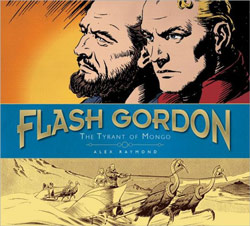
 He took on a high-tech empire decades before Luke Skywalker and his friends challenged Darth Vader and his Emperor. He was leading bands of freemen in guerrilla operations years before Frank Herbert recorded the adventures of Paul Atreides in his classic science fiction novel Dune. Of course, I’m talking about that fictional character whose adventures are the subject of one of the catchiest Queen songs ever: Flash Gordon.
Flash made his debut in newspaper comic strips in 1934 and would go on to become one of the most influential science fiction heroes of all time. His four-color adventures and the movie serials based on them would inspire the creation of landmark science fiction franchises like Star Trek and Star Wars. The reason Flash’s adventures had such a monumental impact on popular culture was because of the creators involved: the artist Alex Raymond and the strip’s writer Don Moore. Recently fans in the U.S. have been given a chance to rediscover or become acquainted with Raymond and Moore’s Flash Gordon work thanks to a beautiful series of library edition hardcovers.
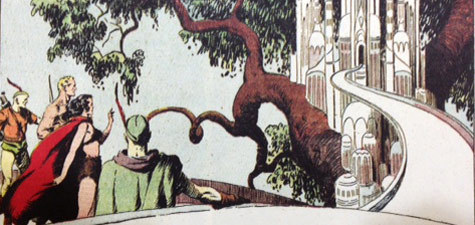
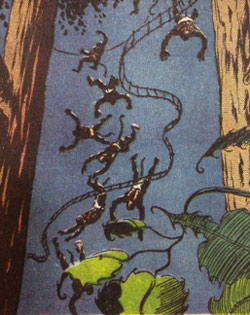
In the collected edition’s first story “The Beast Men of Mongo” you’re taken to a vast tree city which clearly influenced later arboreal civilizations like the Ewoks’ of Return of the Jedi. There would, of course, be no icy planet of Hoth if George Lucas and the production staff of the Empire Strikes Back had not read the book’s fourth story, “The Ice Kingdom of Mongo.” The locales aren’t the only influential elements though.
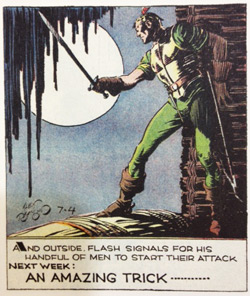
Flash himself is a blond-haired man in top physical shape taking on a fascist empire with muscles, courage, cunning, and sense of decency. That’s a good way to describe another famous four-color hero.
 Co-created by the legendary artist Jack Kirby, Captain America made his debut in 1941. Kirby was a huge fan of Raymond’s work and you can tell from the way he drew his characters and the technology they would occasionally wield. Raymond’s influence is very apparent in the works of other legendary comic artists like Will Eisner, and Bob Kane, the creator of Batman. So comic book super heroes also owe a debt to Flash Gordon and the work of Alex Raymond.
Raymond’s fantastic imagination and art is the star of The Tyrant of Mongo, but that doesn’t mean the writing is lacking. Don Moore’s five stories in the book are all epic and exciting tales. When you read them together you forget that the stories were told on a weekly page by page basis over several months. They read as grand space operas and each one feeds into the next. So there’s a fun serial feel to the stories, but there’s also plenty of payoff.
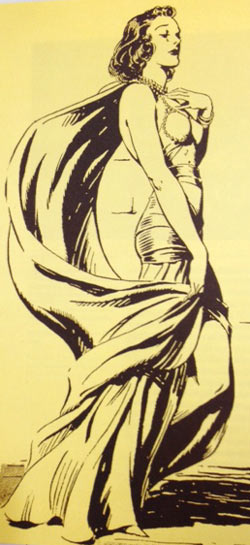 The Tyrant of Mongo really does feel like the exploits of one decent and heroic man trying to make a difference on a corrupt planet. Character relationships mature and develop over months and years, and you’re given a sense of just how much Flash Gordon’s heroism means to people. As Flash travels across Mongo, his legend travels with him. When the downtrodden, outlaw, and helpless citizens of the planet meet Flash, they’re ready to do whatever they can to help him out. It’s truly epic and inspiring.
Since Jerry Siegel and Joe Shuster were fans of Flash, it’s no surprise that four years later they, too, would introduce the world to another hero waging a never ending battle for truth, justice, and the American Way: Superman.
If you’re someone who only knows Flash Gordon because of the campy classic 1980 film starring Sam Jones and Max von Sydow, you really need to do yourself a favor and pick up The Tyrant of Mongo. Not only will you get classic adventure stories, but you’ll also be given a glimpse at the origins of pop culture’s most important and influential science fiction and adventure franchises.
This sweepstakes has ended.
To enter for a chance to win a copy of Flash Gordon: The Tyrant of Mongo: The Complete Flash Gordon Library 1937-1941, make sure you’re a registered member of the site, and then simply leave a comment below.
TIP: Since only comments from registered users will be tabulated, if your user name appears in red above your comment—STOP—go log in, then try commenting again. If your user name appears in black above your comment, You’re In!
NO PURCHASE NECESSARY TO ENTER OR WIN. A purchase does not improve your chances of winning. Sweepstakes open to legal residents of fifty (50) United States and the District of Columbia, who are 18 or older. To enter, fill out entry at https://www.criminalelement.com/blogs/2012/12/fresh-meat-flash-gordon-the-tyrant-of-mongo-complete-library-sundays-1937-1941-by-alex-raymond-and-don-moore beginning at 09:30a.m. Eastern Time (ET) December 17, 2012. Sweepstakes ends at 09:29 a.m. ET on December 24, 2012 (the “Promotion Period”). Void outside of the 50 US and DC and where prohibited by law. Please see full details and official rules at https://www.criminalelement.com/page/official-rules-flash-gordon-the-tyrant-of-mongo-comments-contest. Sponsor: Macmillan, 175 Fifth Ave., New York, NY 10010
Dave Richards covers all things Marvel Comics for the Eisner Award-winning website Comic Book Resources and his book reviews and other musings can be found at his blog Pop Culture Vulture.
Love Flash Gordon. I’ve been thrilling to his adventures for years.
This looks cool.
It’s surprising that in this age of huge franchises in pop culture that Flash Gordon hasn’t been “rebooted” by a major studio. But, the Sam Jones/Max Von Sydow version is still a campy fun time!
All I can say is AWESOME!
I’m a long time fan of Flash Gordon. As a child I remember watching the tv show each week with new chapters of the story.
I own a few dvd’s of the old series also. I’d love to win this book for my collection.
Sounds like fun – thanks for the giveaway
WOW! I’d love to win this, I’m a big fan of the old comics. Plus, my birthday is coming up and this would be an awesome gift 🙂
A classic indeed!
It would make a great Christmas gift!
Great comic. Would love to win.
Count me in !!!
Epic and inspiring . . . sounds like a great book!
It would be awesome to put in my collection!
It would be awesome to put in my collection!
Shiny!
I became hooked on Flash Gordon when a local TV station played the old serial episodes. Would love to own this collection!
[b][color=rgb(64, 224, 208)]Happy memories, love to add to my library![/color][/b]
This book looks fantastic!
Great art and stories.
This sounds like something that my husband would love to read. Great memories of a wonderful childhood also. Would love to win.
i love to read these
Alex Raymond was one of the truly great comic creators. I’d love to win this collection!
Would love to start at the beginning and read through all of them!
This is sucha cool collection!!
There’s no denying the artwork on the strips is beautiful. And back then the printed strips were of a size that the art could be appreciated. It would be very tough to have these strips appear on current comics pages.
Great collection!
Cool!!
I read that George Lucas originally intended to do a new Flash Gordon movie but could not get the rights so we got Star Wars instead. Flash Gordon is still the best of the best. Thanks for making this available
I read that George Lucas originally intended to do a new Flash Gordon
movie but could not get the rights so we got Star Wars instead. Flash
Gordon is still the best of the best. Thanks for making this available
Flash and Ming!
Awesome now my kids will be able to read it now.
If I won this Flash Gordon set, I would be my teenaged son’s hero! He would buy me a cape and call me Supermom! Thanks for this amazing giveaway!
I have been in love with Flash Gordon since a child watching the TV shows! I’d love to win this set of books – but just in case I don’t, I’m going to buy the set anway! (Then I can give this set to my son for Christmas!)
This would make an awesome gift for my dad! He loved Flash Gordon!
Would be great to read it again!
Love, Love, Love!
This looks great. And like something I could never buy on my own…
One of the great strips by one of the greatest comics artists of all time.
love flash gordon!love the artwork also,great!
Love Flash
My Dad introduced me to Flash Gordon years ago with the movie in the 80’s. Now I’m a huge fan!
I love the battle between Flash and Ming.
Please accept my entry. Thank you.
A whole big book of the legendary Alex Raymond. Wow, what a prize.
I have a grandson who is an aspiring graphic novelist. He’d love this!
Flash Lives!
What a great book!
Ooh, Flash Gordon! (I’m the only one with the cheesy ’80s theme song in my head, right?)
Beauitful atrwork. Underappreciated…
Our sons would really enly this…
Thanks, Cindi
jchoppes[at]hotmail[dot]com
I’m a long-time Flash Gordon fan and would love to have this volume.
Been a long time Flash Gordon fan
Great collection. Whoever wins ought to be very pleased.
FLASH IS AWESOME. I LOVE WATCHING THE OLD SERIALS ON TAPE.
thanks
thanks
Wow, this is amazing! Thanks for the chance 🙂
Thanks for the chance to win a copy!
What a great gift!
It would really make my Christmas, and my year, if I won this beautiful item. Thank you so much for the chance to enter. Flash!
Some fond memories would be a great gift. Thank you for offering me the chance.
Would love the chance to explore all the lands of Mongo!
I can’t believe that there have been over sixty comments, and no one has yet said … GORDON’S ALIVE!
So cool! I would really, really like to win this.
Alex Raymond’s Flash Gordon work has always been a favorite of mine. This book will be a great addition to my library.
Flash Gordon is a classic. Does anyone else remember the Filmation Saturday morning cartoon? They kept the character style surprisingly true to the comic strip. That was a favorite show when I was a kid, well except for the second season when they added a goofy flying dragon. Thank you for the great giveaway.
Always loved Flash Gordon and the rest of the gang.
always dug flash gordon, would love this
Don’t be Merciless, enter me in a Flash.
Flash hasn’t been treated well in mainstream media. It’s nice to see him getting the treatment he deserves.
A great strip in book form – wonderful!
I can’t wait! I have enjoyed Flash Gordon for years!
this looks great. I would love to win this. I have always been a fan of Flash Gordon.
This looks amazing. Flash Gordon brings back such great memories.
It would be interesting to see some original Flash Gordon.
would love to win a copy for my son big super hero fan.
thanks-my son would love this
I love Alex Raymond. I’m an artist, and he had a big influence on me — and more importantly, on my mentor. I think his FG work is among his best stuff.
Flash a-ah
Savior of the Universe
I would love to win this!
Flash Flash baby!
Flash Gordon Mega Fan here!
I have been a fan of Flash Gordon, since I had a chance to meet Buster Crabbe at a festival and was introduced to the character through the old film serials.
My husband and I grew up watching the Flash Gordon serials on “Matinee at the Bijou.” I bought him some of the individual volumes of the Alex Raymond strips, but I wasn’t able to complete the collection. It’s good to know all the strips are now available in one book. They’re really beautiful!
My husband and I grew up watching the Flash Gordon serials on “Matinee at the Bijou.” I bought him some of the individual volumes of the Alex Raymond strips, but I wasn’t able to complete the collection. It’s good to know all the strips are now available in one book. They’re really
beautiful! And now, my name should be in black.
i used to watch the old serials as a kid . . . great idea, great contest.
would love to win & read! PICK ME!!
Love Flash G. Would love to share with DH and DS.
FLASH IS MY HERO.
LOVE THE COMICS.
WATCH ALL THE SERIALS AGAIN & AGAIN.
Sounds like a great book. Just read one about Superman’s origins……
Love the old pulps!
Sold! I want this so much!
Flash is an old friend, and I’d love to renew our friendship!
Awesome!!
[b]This would really be an Totally Supertly Awesome prize to win and give to my boyfriend’s 13 yr old son!!![/b]
This is a great gift for everyone who ever enjoyed Flash Gordon – bring it on!
Would so love to have this for my SO…thanks for the chance!
I love Flash Gordan. I grew up reading him. This is awesome!!
I would enjoy reading this so much, thanks for the chance!
Great contest, thanks for the chance to win
Thank you for the great giveaway please count me in 🙂
My husband would love this!
I grew up with Flash – what a great capture this would be for me.
I love and grew up with Flash Gordon
Flash Gordon is my sci-fi hero!! I grew up reading his off world adventures and would LOVE to have this! Thank you for a very AWESOME giveaway
This would make a great Christmas gift……for me!
my bro is a big fan and would love it!
I would love to win this!
This would be great
thank you for the chance to win this
Hey! I loved the 1980 film! But I’d like to check this out too.
I would love to win this.
This would be awesome for my son.
Alex Raymond’s Flash Gordon work has always been a favorite of mine. This book will be a great addition to my library.