
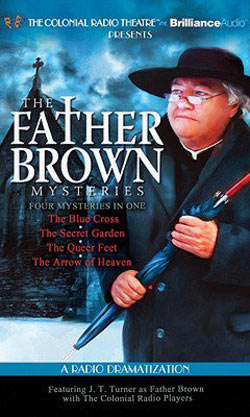
For a while now I’ve been thinking about how fictional clergy/spiritual leaders couple their ecclesiastic training with their personal curiosity to solve the occasional crime that just happens to pop up.
When written, the Father Brown stories were contemporary but the first story, “The Blue Cross,” was published more than one hundred years ago, so now they have a great appeal to fans of historical mysteries. The same can be said for the Sister Fidelma mysteries by Peter Tremayne. Set in the 7th century, most of the novels take place in Ireland, with Fidelma making some journeys to other parts of Western Europe. Tremayne uses Fidelma’s role as both a lawyer and a religious figure to contrast the relatively unrestricted position of women in Irish society with the status of women in other European societies of the time.
If you want a more modern religious sleuth, look no further than Brother Cadfael, the 12th century Benedictine monk residing in western England in the very popular series written by Ellis Peters, which is also a long running television series available on DVD. Cadfael felt the call to religious life in his forties. By that time he’d served as a soldier and a sailor, and participated in the Crusades. During his secular life he had relationships with several women including Miriam, a young Syrian woman, with whom he lived for many years in Antioch. In this clip from the television episode of The Virgin in the Ice, Brother Cadfael realizes that the young crusader he is speaking with is probably his son. It is a tender moment, filled with suspense.
If you get bored with the “good old days” in the British Isles, let me introduce you to Rabbi David Small, who first saw the light of day in the mystery novel Friday the Rabbi Slept Late written by Harry Kemelman and released the same year I graduated from high school, 1964. David Small is rabbi to a Conservative Jewish congregation in the small suburb of Barnard’s Crossing, Massachusetts. On the Friday in question, the dead body of a woman is discovered on the temple grounds. During the following thirty years, Kemelman produced a dozen Rabbi Small novels, and in each one the Rabbi brings his Talmudic wisdom to the crime solving process with great success.
Then in 1994, the first Charlie Moon novel, The Shaman Sings, hit the shelves. Charlie is a rancher and tribal police officer on the Ute Reservation in Southern Colorado. His snappish but entertaining Aunt Daisy Perika, a tribal shaman, helps Charlie solve crimes with her prophetic dreams and supernatural intuition.
The author of the series, James Doss, died a few months ago and did not live to see the release of the seventeenth Charlie Moon mystery, The Old Gray Wolf, this past October. Vanessa Parker described this final Charlie Moon novel in a Fresh Meat post just a few weeks ago.
Okay. So by now you are wondering if all the contemporary Catholic sleuths have disappeared. It seemed for a while that every time we turned around some nun or priest was solving a murder or two or three. Never fear—I know a few we can talk about in a future post. You know who I mean: Father Koestler, Sister Mary Theresa Dempsey, Father Dowling, Sister Mary Helen, and my personal favorite, the inimitable Chicago Bulls fan, Bishop Blackie Ryan.
In the meantime, let’s talk about your favorite clergy sleuths and why you think that religion and crime fit so nicely together.
Terrie Farley Moran’s recent collection of short stories, THE AWARENESS and other deadly tales, is currently available in e-format for the Nook and the Kindle. Terrie blogs at Women of Mystery and her short story “Jake Says Hello” can be found in the December 2012 issue of Alfred Hitchcock Mystery Magazine.
Read all posts by Terrie Farley Moran for Criminal Element.
My fave clergy/amateur sleuth is Julia Spencer-Fleming’s Clare Fergusson! An episcopalian minister and former army helicopter pilot with a nose for trouble and a quick tongue–such an unconventional heroine. Love her and the whole Millers Kill series.
I’m a Cadfael woman myself. And my favorite mixture of religion and murder is a book that features a newscaster as the sleuth name Jemima Shore. The book is called Quiet As A Nun by Antonia Fraser. It’s an oldie but a goodie.
@Taragel: She’s exactly why I came in here. I love that series so much.
Taragel and Alicia, I couldn’t agree more. I loved the Clare Fergusson books right from the start, In the Bleak Mid Winter. I do think that One Was A Soldier is the best of the series (so far.) And I really like her relationship with Russ Van Alstyne.
This is only one clergy/sleuth post. Another Criminal Element blogger has put together a post but I don’t know what series she’s decided to write about. Stay tuned you never know what will pop up here at CE.
Deb, thanks for the intro to Quiet as a Nun.
Another contemporary UK offering is the Merrily Watkins series by Phil Rickman, in which Merrily is an Anglican minister based in Herefordshire who becomes involved with Deliverance (aka Excorcism). The characters are well-developed and the plots are a masterful mix of contemporary events and possible supernatural influences.
Nancy, thanks so much. The Merrily Watkins series sounds like books I would enjoy.
I, too, love Julia Spencer-Fleming’s series about Rev. Clare Ferguson and police chief Russ Van Alstyne. This series’ books are on my automatic-buy list. I love the characters and the setting and the occasional bursts of humor. A wonderful series I can’t rave enough about.
A couple other authors writing about clerical sleuths now: G.M. Malliet, who writes about a vicar in a small English country village (who used to be an MI5 agent) and Ilene Schneider, who writes about a female rabbi in New Jersey. Both authors are writing series, with the second book in each series having just come out this fall.
And while I’m here, let me add that I have a sort-of clerical sleuth in one of my short stories: Job. In “The Lord Is My Shamus” God sends Job back to Earth to do some detecting for him. I figure if God’s involved, the story can fit into the clerical category. : ) The story appears in Chesapeake Crimes: This Job Is Murder, which came out earlier this year from Wildside Press.
Not a formal member of the clergy, (Mellville Davisson Post’s) Uncle Abner belongs in the group. And Jesuit priest Father Mark Townsend solves cases in the Pacific Northwest and Alaska beginning with “The Story Knife” by Father Brad Reynolds, a real-life Jesuit priest.
Barb and Jeff, thanks so much for adding to the clergy/sleuth TBR pile!
I’m delighted that the clerical sleuths are so popular. There are a couple of newer posts here on Criminal Element. Look around!
Just had the time to figure this out. The Antonia Fraser series was excellent. Hope those of you who are interested can find copies.
Two things: have you read the Margaret Frazier “Sister Frevise” series. It is very well written, especially since it was a collaberation for a time. And finally, I think Leo McKern would have been a much better Brother Cadfael. I always pictured him as being a rather earthy but open and friendly person. Guess I believe the religious don’t have to be s-o-o-o serious. Some of the best pastors I’ve known were extroverts, but still very committed to their beliefs. The actor who played Cadfael was a bit too somber and epicene, and I can’t see his Cadfael enjoying life very much.
I have not read the Sister Frevise books but I will certainly look for them. Thanks for the intro. Leo McKern as Cadfael. I hadn’t thought of it.