
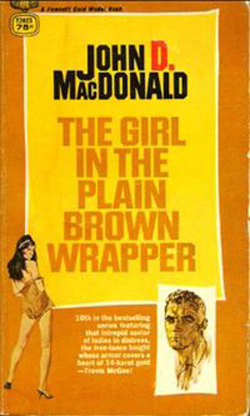
But I think MacDonald is most widely remembered as the author who introduced Florida in all its vivid flashes of color to millions of readers when he created Travis McGee, a cool guy, who lived on an even cooler boat, The Busted Flush. The twenty-one Travis McGee novels ran the gamut of hues from The Deep Blue Goodbye (1964) to The Lonely Silver Rain (1985).
Florida is a fabulous location for any and all fiction, but especially for crime fiction. The state has a reputation for reflecting “summer time and the living is easy” twelve months a year. And while it attracts earnest citizens looking for a better life, it also attracts grifters, con artists, and ne’er-do-wells bent on creating their own brand of the high life by fleecing, threatening, or even killing the earnest citizens. And there was Travis McGee, ready and more than able, to help the earnest citizen and take out the bad guys.
Unfortunately, MacDonald died in 1986, so I’m not sure if he saw the first solo novel of Miami Herald columnist, Carl Hiaasen. A native Floridian, Hiaasen energized the world view of Florida as a wild and wacky place inhabited by folks who give new meaning to the word “character.” Hiaasen’s hilarious debut solo novel, Tourist Season, was hailed as one of the funniest views of Florida life ever written. His next book, Double Whammy has always been billed as the first (and possibly the only) novel about sex, murder, and corruption on the professional bass-fishing circuit. His imaginative view of Florida is not only available in fun novels for adults. Hiaasen also writes for kids, an audience that has responded with great interest and grand laughter to books with titles like Scat and Flush. The cover of his latest YA book, Chomp, has only the title and an open mouthed alligator on the cover. Sure to dazzle the kids, hoping that the gator will chomp a bad guy or two.
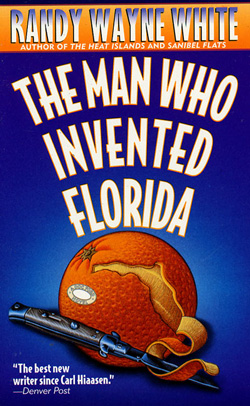
Recently, White introduced a new protagonist, Hannah Smith, in the novel, Gone. Hannah makes her living as a fishing guide but has a reputation as a no-nonsense person who can correct any problems her friends and customers might have. When a girl goes missing, Hannah is asked to find her, leading to an intricate story wrapped in White’s trademark: a complex plot and a brilliant sense of place.
For a lighter touch of Florida humor filled with family chaos and a dead body or two, I can always rely on Deborah Sharp’s Mace Bauer mysteries. My favorite of the series, Mama Rides Shotgun, weaves some nice Florida history while a murder occurs and is eventually solved. Mace, the middle daughter and her oft-married Mama follow the old Florida Cracker Trail on horseback across the state. (Did you know the term cracker comes from the sound of the whips the cowboys used on cattle drives? Did you even know that Florida was once a big cattle state?) Most impressive of all, Deborah Sharp actually mounted a horse and road the trail herself as research for the book. And it’s a long trail.
Florida lends itself to eccentric characters and quirky landscape and these authors repeatedly present us with the best the state has to offer in crime writing. If you haven’t read a mystery set in Florida for a while, the time is now.
Terrie Farley Moran’s recent collection of short stories, THE AWARENESS and other deadly tales, is currently available in e-format for the Nook and the Kindle. Terrie blogs at Women of Mystery, and her short story “Fontaine House,” set in—where else?—south Florida, can be found in the August 2012 issue of Ellery Queen Mystery Magazine.
Read all posts by Terrie Farley Moran for Criminal Element.
Glad to see this shout out to Florida’s thriller writers. Of course, as Hiaasen himself frequently points out, all he has to do to find ideas is to read the daily papers because Florida is the national capital of weird. Even Florida true-crime stories can be wild & wacky — for instance, the new book [u]The Scent of Scandal[/u], which delves into weird world of orchid-smuggling in two Florida-based criminal cases.
Put [url=http://www.laurenceshames.com/]Laurence Shames [/url]on your list of Florida writers, especially if you’re a Hiaasen fan. Shames has a series of books set in Key West with a feel very similar to Hiaasen–plenty of humor and wry observations. The first one is Florida Straits, which I think came out in the 1990s. Good fun. 🙂
@ Fred thanks so much for the intro to Florida true crime ! A whole new avenue of adventure.
@ Leslie, I can’t believe that I’ve not yet heard of Laurence Soames. I have some catching up to do.
Also, John Lutz, and above all, Charles Willeford.
I agree with Leslie .. Laurence Shames is one of my favorites. Florida has such a talented bunch of writers, and I’m HUMBLED you chose to mention my series in such fine company.
Can I put in a plug for Tim Dorsey? If you’re going to read Carl Hiaasen (and I heartily recommend you do), then take a gander through Tim’s works, as well. Tim’s based in Tampa and many of his books are set around there, BUT he (and his protagonist) are fans of the entire state and they do travel around. AND he reminds me a lot of Hiassen, but not as serious as Carl’s books are (sarcastically added)! (Also, watch for the occasional guest appearance of characters inspired by Randy Wayne White!)
What a great post! Love all the Florida writer recommendations.
Wow! thanks everyone for your introductions to writers I’ve never read. Give me a few months to hunt down some books and perhaps we can revisit Florida–it seems to be a very popular topic.
When I mentioned Carl Haissen’s latest YA novel, Chomp, I forgot to link Victoria Janssen’s Fresh Meat post telling us all about it. [b][url=http://www.criminalelement.com/blogs/2012/03/fresh-meat-chomp-by-carl-hiaasen]You can link it here[/url][/b].