
The Five Points was named for streets at a five point intersection of Orange, Anthony, and Cross Streets, the names of which changed over time. Little to nothing of the Five Points exists today; the land is a part of Chinatown. Just south of that historic intersection now sits New York City’s federal and state courthouse square, the one used for the exterior shots for Law and Order. Maybe that’s fitting. The Five Points was known as a “bad neighborhood” for nearly eighty years. But, like any “bad neighborhood,” there’s always a more complex narrative than reputation alone.
Founded around 1820 by increasing waves of Irish, Italian, Chinese, then German, African-American, and Eastern European Jews flowing into New York City, the insanely overcrowded area witnessed and/or participated in nearly every type of political scandal, scam, and infamous riot. Houses of vice, gambling, prostitution, and opium were common, and alcoholism was rampant. Yet it was a neighborhood filled with diverse, exciting creativity. Home to boxing rings, cheap theatres and dance halls, it became the birthplace of tap dance when African-American traditional dances met the Irish jig. Charles Dickens wrote about the Five Points dance halls (it seemed it was the only part of this country he really enjoyed). I’m fairly certain we owe our modern Musical Theatre, a distinctly American invention, to the wild and intriguing Five Points.
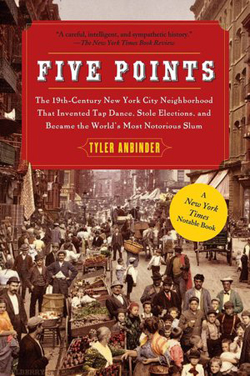 The most reliable, comprehensive source material on the area is the book Five Points by Tyler Anbinder. The novel Gangs of New York that served as a basis for the film of the same name presents shoddy truths, makes sweeping assumptions and gives the area a more theatrical, even vaudevillian spin. While The Five Points was a larger-than-life neighborhood, not everyone who lived there was a criminal. Anbinder’s Five Points takes the reader inside a lethally dense neighborhood struck by abject poverty, fighting to survive despite the problems and vices that neglect and lack of resources create.
Tenement conditions were horrid, without running water or ventilation, the five- or six-story brick buildings were cold in the winter and sweltering in the summer. Overcrowded buildings with no regulations or incentives for landlords to take care of their properties meant the threat of fire was a constant worry, as were freezing cold nights. Both extremes brought waves of disease. Sickness made keeping steady work impossible. Poverty, illness and systemic neglect became cyclical problems while lurid stories of crime and vice—the newspapers couldn’t be trusted not to trump up facts for the sake of selling scandal—kept outsiders horrified yet fascinated. When some institutions felt compelled to help (and to convert), various Protestant charity houses were established.
Five Pointers were key players in every major political shift of the mid- to late-nineteenth century, greasing the wheel for what would become the infamous Tammany Hall machine. Five Pointers were significant in making elite powers realize that the working and lower classes were a force to be reckoned with, in numbers, zeal, and often brute force. Five Pointers were also at the epicenter of racial fault lines, as demonstrated in the race riot of 1834 and the 1863 Draft Riots borne from Irish rage at being drafted into the Civil War (wealthy New Yorkers could buy their way out of the draft with 300 dollars), and this anger was made manifest in mobbing and murdering black New Yorkers.
When Jacob Riis published his famous How The Other Half Lives in 1890 and the world saw the conditions of the Lower East Side in photographic, shocking detail, the revelation signaled the beginning of the end of the Five Points and overcrowded tenement areas. The demand for new laws and regulation was strong but it took years for reform. The lack of parks and breathable, open spaces was a key theme of Riis’s work; the fact that infamous Mulberry Bend became a public park by the end of the century proved he had not toiled in vain.
The Five Points had its stain and sin, but it was also a crucible for those who sought for a better chance at life than the worlds they left behind upon immigration. And while many fell to the area’s vice, many more found ways to provide for themselves, their families and their community, striving to better the chances for their future generations. It was a place where working-class New Yorkers came from all around the city to play as hard as they worked, in a passionate, diverse environment. In order to understand the immigrant experience of America then and now, and certainly the narrative of America’s foremost metropolis, one should take a moment and consider The Five Points.
Leanna Renee Hieber is an award-winning, nationally best-selling author of Gothic Victorian paranormal fiction such as the Strangely Beautiful series and her Magic Most Foul saga set in 1880 New York City. The Magic Most Foul saga, beginning with Darker Still: A Novel of Magic Most Foul, an Indie Next List recommended buy by the ABA and a Scholastic “Highly Recommended” title, will continue with The Twisted Tragedy of Miss Natalie Stewart this November. More information on her website, on Twitter, and on Facebook.
I have always been interested in New York City history, and appreciate your vision of The Five Points as a place where new Americans blended with other new Americans, and folks tried to do better for their families. Yes, the crime was “romantic” but the life was hardscrabble. Still they managed and now here their descendents sit–comfortable in our recliners, waiting for COPPERS to begin. Thanks for a great post.
I love getting multiple views of a place, so that, at least in my mind, I feel like I’m getting a fuller understanding. This place and century in America is so compelling–thanks for a broader perspective!
Terrie,
Thank you! It is indeed important to think about that line of descendents as we “look back” while presently anticipating COPPER. I’m excited to see what they do with the show, I trust the BBC with period work FAR more than I do Hollywood. I hope to come back and chat about it with all of you.
Clare2e,
I think the only way you ever can get to know any place, any one, or any thing, is by multiple views and viewpoints, I really appreciate you saying so. Thanks for stopping by!
[url=http://leannareneehieber.com]Leanna Renee Hieber[/url]
[url=http://twitter.com/leannarenee]@LeannaRenee[/url]
History has always been of interest to me, especially early american history. Being a resident of New York City, I am intrigued by the stories that circulate from the infamous Five Points. Reading your article has made me go and procure a copy of Mr. Tyler Anbinder’s book, because you described it as the most reliable comprehensive source material on the area. I’ve started reading and Iam captivated by its contents. I like to read aloud and my brother has informed me that I’m not to read unless he is in my presence, because like me he to finds the material just as interesting. Thank you for your article and I look forward to finishing Mr. Anbinder’s book.
I GREW UP THERE IN THE 50’s WHOEVER DID THE RESEARCH HIT IT RIGHT ON THE HEAD THE OTHER STREETS WERE MOTT AND SPRING LITTLE ITALYIS ALMOST GONE THE ONLY ITALIAN THING GOING ON DURING THE YEAR IS INTHE 2nd WEEK IN SEPT WHEN THE FEAST OF SAN GENARRO RUNS FOR 2WEEKS
I am fascinated by the history of NYC in the latter half of the nineteenth century, I enjoy reading fiction of this period, particularly with reference to the five points.
I vividly remember one book mentioning the Orange riot of 1871, and commenting on the rooftop Catholic gunmen/snipers and the line “and 70 people died that day for the right of Irish Protestants to parade the streets of New York.”
Unfortunately I can remember neither the author nor the title, can anyone help?