
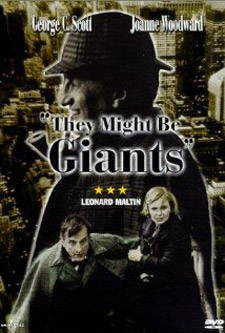
 In 1971, Universal Pictures produced a film titled They Might Be Giants starring George C. Scott and Joanne Woodward as, respectively, “Sherlock Holmes” and Dr. Mildred Watson, chronicling their adventures fighting crime in New York City. Sound familiar? But wait, it gets better. This Holmes is in fact a mental patient by the heroic name of Justin Playfair, whose life is in real danger due to his grasping elder brother’s attempt to usurp the family estate. When Dr. Watson is naturally seized upon as Playfair’s partner in imaginary mayhem, the pair gallivant about Manhattan fighting foes both real and illusory, all the while pretending to be the dynamic duo of the Victorian era.
But They Might Be Giants, for all its Sherlockian iconography, isn’t a Sherlock Holmes reimagining. In fact it’s a Don Quixote pastiche, and an admirable one—it’s about defying reality when reality is too grim or too dull or too heartbreaking, about falling in love with heroism and refusing to be told that the world no longer needs justice served up by brilliant vigilantes.
It takes Cervantes’s novel as its inspiration and delightfully tweaks it for a modern era.
It respects the spirit of the source material.
And that, makers of CBS’s Elementary, is why I must apologize to you for recent murmurs of Sherlockian pissiness. Because some of us fear you don’t get that principle. At all.
There will always be room for more adaptations of Sherlock Holmes. The problem isn’t that the Warner Brothers films and BBC’s Sherlock already exist, and that they are good, and that we by and large love them. Nothing is wrong with adding your sprightly potato salad to our geek potluck and passing around the plastic forks. We are still hungry. No, the problem is that we fear the ethos of our beloved characters will be ignored in favor of market research and general Los Angeles willy-nillying, and we already have a bit of a sugar high from all the Holmesian brilliance of late, and from over here, it looks like you made your potato salad with daikon radish, and that isn’t what a potato salad is, CBS.
It’s a widely accepted fact among our ranks that you can turn Sherlock Holmes into almost anything and he will still rock harder than David Bowie circa 1972. Make him a cartoon mouse called Basil. Please. Put him in the 22nd century with a robot friend. Update him to a dangerously pretty self-avowed sociopath in a Belstaff coat—go on, we dare you, it works like a charm. Nearly anything can be done to the world of Holmes and Watson so long as the creators understand that we as rabid Sherlockians have certain expectations. (As for non-Sherlockians, go ahead and throw any hard-edged cop drama you like their way and call it Mr. Sherlock Holmes of 221B Baker Street and Dr. John Watson, CRIMEBUSTERS. They won’t notice the things we will.)
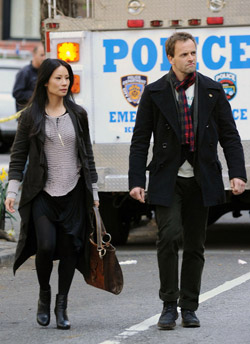
Admittedly, some of your ideas are quite sound, CBS. Including but not exclusively . . .
- So you tell us that Holmes and Watson are “a crime-solving duo that cracks the NYPD’s most impossible cases.” Fine, we can lose London. Peace out, capital of the British Empire, we’re shaking up this game.
- Sherlock Holmes is an addict who has just come off a stint in rehab. We buy it. The Holmes of the canon did his share of morphine and intravenous coke, and in fact Watson “gradually weaned him from that drug mania which had threatened once to check his remarkable career.” Rehab it is, we have stronger candy these days.
- Quoted from radiotimes.com (as indeed is all of this information), Joan Watson is the “‘elementary’ choice to keep the ‘mischievous’ Sherlock Holmes grounded as he ‘[runs] free in New York solving crimes.’” How right could you possibly be? Without Watson, Holmes would probably lose his gravitational pull and fly off the planet. Also, Sherlock Holmes is hilarious and likes to prank his clients with naval treaties delivered in breakfast trays. Gold star, CBS.*
- Holmes’s professional counterpart is Tobias Gregson, played by Aidan Quinn. This is nothing other than true canonical fact, and we as fans thank you for it. It makes us feel warm and comfortable and right at home, as if we sat in scrambled eggs.
So again, apologies for our tetchiness on the following subjects, which are alarmingly centered around a particular character . . .
- Make Dr. John H. Watson, M.D., a woman, no worries. And by all means cast Lucy Liu, who is a turbo-charged nitrobadass. So, let us tell you about Watson, who is our universal hero and our mascot and is loved by us all and if you wreck the character we’ll come after you with arsenic-tipped pitchforks. Ready? He’s an army veteran who was wounded in action. So obviously she’ll be . . . what? Really? No? Ah . . . hmm. But women serve in the armed forces in Iraq and Afghanistan as we speak, and they’re incredibly brave, and it would be a tribute and. . . But . . . are you sure? Right, then. No army record, no formal training with deadly weapons.
- Can we talk more about Watson? Because we love the subject. Great. So, Watson is only a general practitioner, but a very competent doctor, and . . . what’s that you say? Your version . . . isn’t a doctor? She . . . lost her medical license due to a patient’s death, you say? And she’s “paying a penance” by working as a sober caretaker? Aha. Oh. Well, maybe that is . . . something you’ll explain, you darling CBS folk.
- We have a really hard time getting off the topic of Watson, we know, it’s admittedly embarrassing, but one very important part of the mythology is that he’s alone in London, just spiritually adrift, and he needs a cause, so get this, he meets an amazing consulting detective who completely fascinates him and . . . I beg your pardon? She’s forced to live with Holmes as his sober companion at Holmes’s wealthy father’s behest? You know something, this potato salad you just spooned onto my plate seems to be mainly daikon radishes and ox knuckles. What’s that about?
I’m not arguing that we’re purists, because we aren’t in general, but we have trepidations because frankly Watson is the heart and soul of the matter—strip him of everything he stands for, and what’s left of him? You’re not giving us a Sherlock Holmes who’s a dense, plodding Puritan who slowly solves crime by textual procedure, presumably. So, CBS, what are you doing with the most important character from the books?
One makes the assumption that the bond between Sherlock and Joan will begin feisty and steadily grow, which sounds like a fantastic X-Files remake, and I’m glad you’re making it. Truly. And our gross irascibility (for which I am personally sorry) might be erased by our spellbound awe at the sheer purity of beauty that Elementary offers as a series, such that we come to you upon our knees, begging to wash your feet with our hair. That might happen, CBS.
For instance, that might happen if Joan Watson shoots criminals when Sherlock Holmes is too lazy to bring the service revolver. Or if she bangs men (or women) from “many nations and three separate continents” and the celibate Holmes ribs her about it continually. Or if she is there for him no matter what the circumstance and no matter the cost to her, through thick and through thin, watching him be amazing, because Holmes is the single great relationship of her life, and she knows it.
But don’t hand us a plate consisting of daikon, ox knuckle, and peanut butter and brightly tell us it’s potato salad, CBS. Because we may not be purists, but no one on earth loves their chosen dish better. Fair warning.
*Regarding “elementary”: you keep using that word. I do not think it means what you think it means.
Lyndsay Faye is the author of Dust and Shadow and The Gods of Gotham. She tweets @LyndsayFaye.
Read all posts by Lyndsay Faye for Criminal Element.
Oh, dear. Though still cautiously optimistic, I’m more wary of this now. Giving Joan a military background would’ve been fitting not just for Watson but for Liu, who’s certainly shown she can handle weapons. I don’t want any ox knuckles in my potato salad. They sound really unappetizing.
Thanks for this insightful post, Lyndsay.
I came for the Watson love and stayed for the Inigo quote. Thank you Lyndsay. I don’t believe it could have been said better.
Also, is it just me or is the chemistry looking completly forced? Who else pictured that apology scene happening with Cumberbatch and Freeman, only in that one Holmes was incredibly annoyed with the idea of apologizing and John was patienitly and lovingly forcing it out of him… Just me?
@cmorgan – I’m with you. It looks totally forced if it exists at all.
I was so excited about the BBC version when I first saw the promos and I watch this and am not excited at all.
As I’m a Pollyanna, I live in hope, even if sometimes ill-placed. I do not want to see a shlumpy, less-than brave and bold Watson, but I’ll give the show a chance to find its feet. Some shows I’ve really enjoyed did their best near the end of the first season. I find pilots especially are so busy laying down backstory that they can be very awkward.
(On a totally unrelated note, that’s what I still admire about Twin Peaks. That was a captivatingly GREAT pilot.)
Isn’t it possible for someone to like both, i get so much for looking forward to it, i agree totally with you Lyndsay and i still can’t wait! 😀
I don’t mind that she’s not a war veteran or a licensed doctor anymore. Mildred Watson in “They Might Be Giants” wasn’t a war veteran, and she was some kind of psychiatrist. Jane Watson (played by Margaret Colin) in “The Return of Sherlock Holmes” movie pilot was neither a doctor nor a veteran. She was a private detective. I loved her, and the wonderful Sherlockian references throughout the movie. This show can be great as long as their working relationship as crimefighting partners is right. I want her to kick ass and be smart, not dumb and bumbling. If that’s good, then I don’t care if she doesn’t have a war wound. In fact “paying a penance” sounds to me like a hint that she’ll have a moral journey of redemption, and not just be a straight man for Holmes’s antics. At least, that’s my hope.
It drives me bonkers to see Sherlock Holmes scruffy and unshaved. He was known to be a first of the first, ‘metrosexuals’ — “clean as a cat” when dealing with his own appearance despite the clutter around him at 221b Baker Street. Scrub up our hero and give him a facial. Quit making him appear if he’s so 1995-ish. It’s 2012 and clean-shaven is back in — or did Hollywood not get the men’s fashion memo?
Lyndsay,
Thank you for what was absolutely the most intellgent, well researched and monumental article on this subject I also approach with much trepidation. I have been writing and ranting about the implications of this series being realized since the whispers began.
Your words are always genius and a pleasure to read. I’ve been saying in my stage shows and lectures “There’s nothing ‘Elementary’ about Sherlock Holmes” like a broken record. The fact they based the name of the show on a common misconception speaks volumes to the forethought that has been put into this on CBS part.
I cannot foresake mentioning that you ended your article with my all time favorite quote from Mandy Patinkin in “The Princess Bride.” Its relevance was not lost on this American Mentalist.
Nice touch Mrs. Faye
-Joe Riggs (@WorldOfJoeRiggs)
Thank you for that footnote on the show’s title. This whole article is spot on, and that was just the icing on the cake.
I couldn’t have said it better myself.
Give Lucy the Sherlock Holmes role and make the guy Watson. Maybe then you’ll go down in history.
This is beautifully written and very well argued. Thank you.
My friends and I are actually pretty optimistic about this. I, for one, have quite a bit of faith in CBS pulling off the relationship between Holmes and Watson because the network is very good at giving us detective series centered around circles of devoted friends. Think Magnum PI, NCIS and the reimagined Hawaii Five-O.
The last one, in particular, is a good one to mention in that, having watched both the original and the remake, I am almost positive that CBS calls the new program Hawaii Five-0 (a zero in place of the letter this time) and named the characters after the ones from the 1968-80 original solely because somebody wanted an excuse to film where it’s sunny and to play that awesome theme music. It is nothing like the original series at all. Nevertheless, it’s great fun to watch because not only does it feature interesting, if often wacky, cases, an increasing intriguing story arc and clever nods to original series, but also because of the back-and-forth between the heroes, who are great friends who happen to be very funny when they get on each other’s nerves. (If you’ve never seen it, I highly recommend the one with Ed Asner.)
CBS crime shows are also full of magnificent female characters like Five-0’s gender-flipped Kono and Abby and Ziva from NCIS. I doubt they’ll allow Joan Watson to simply stand around screaming in the background.
One thing to remember: you made a good point abut how those unfamiliar with Holmes will, if it’s good, welcome another fine procedural regardless of the source material. Even though we fans may bristle at the idea of someone messing about with Watson to this extent, CBS has to cast the net a great deal wider than that. They have to think about not only attracting established fans but also people outside the fan base.
I myself am looking forward to seeing Joan Watson in action. Sure, the trailer could be a bit better, but I like how the focus is on Watson’s history as a doctor rather than as a soldier. As far as I’m concerned, the modern take on Watson-as-Afghanistan-veteran belongs solely to Mark Freeman at this point. CBS needs to keep the show from becoming too much like the BBC version– they’re already getting enough flack for having Miller wearing a scarf in that trailer– and one way of doing that is to focus on Watson-as-roving-medical-examiner, something that we haven’t seen too much of in the BBC series so far.
I’m also thinking that Elementary could be a deliberately ironic title. At any rate, it’s more imaginative than Sherlock Holmes in New York or some such title involving the character’s name.
I’ll close with a lovely point made by mscosmostrekker in her You Tube video on the subject. Fans have nothing to lose here. If Elementary is terrific, then we’ll have something else to look forward to; if not, we can always sit around laughing at it. We can make MSTs and parodies and such. Either way, it’ll be great.
Once again, thank you for a beautiful article. I look forward to reading your thoughts on the pilot in the fall.
I need to make a correction. The name of the actor who plays Dr. Watson in the BBC series Sherlock is Martin Freeman, not Mark Freeman as stated above. My apologies to the actor, who is incredible, and to the readers of this site for my error.
As far as the rest of my comment is concerned, I still believe in CBS.
Thanks everyone so much for all this discussion–and thank you to the last commenter for pointing out more clearly than I did that if Elementary is good, bravo! and if not, what grand fun we’ll have with it! Well stated, as are all these remarks. I appreciate it.
A very insightful analysis, well done.
‘Elementary’ may turn out to be a good TV show, but it is NOT Sherlock Holmes, at least not the character I’ve loved since I was ten years old. (My daughter turns 25 today so you can guess the maths).
At the risk of sounding cynical – ahem – I would say the reason Lucy Liu was cast as Watson instead of Holmes is because she didn’t have the Cumberbatch-connection that JL Miller has.
I see CBS has decided to file a restraining order against the producers of ‘Glass Houses’. Give the way they behaved towards Moffat & Co. that strikes me as chutzpah of the highest order. ‘Elementary’ may not be a carbon copy of ‘Sherlock’ but what’s the bet it wouldn’t even exist had ‘Sherlock’ not first been such a smash hit?
And in the spirit of your Inigo quote I have a vision of Moffat facing down CBS with a sword and the words, ‘Hello, my name is Steven Moffat, you killed (or at least wounded) my hit show. Prepare to die!’
Yeah, it’s too bad that CBS decided to slip some of that nasty Asian daikon radish into Sir Arthur Conan Doyle’s lovely white potato salad, isn’t it?
News flash: that metaphor isn’t as clever as you probably thought it was.
Well, I’m a highly sceptical Holmes fan, hoping for good, but not expecting it.