
Earlier this year, Jake Hinkson provided a thoughtful examination of High Noon in honor of the film’s sixtieth anniversary. This movie comes from the school of “a man’s got to do what a man’s got to do,” a common western theme. Newly married town marshal Will Kane (Gary Cooper) quits his job only to learn that an arch-enemy is coming to town to kill him. In spite of his wife’s pleading and in spite of no one in the town being willing to help him, Kane does “what a man’s got to do,” and stands alone to fight.
And in another article comparing Shane to the 2011 movie Drive, Jake Hinkson says, “Both films are about unconsummated passion and unspoken love and the way these feelings are channeled into acts of violence.”
Shane (Alan Ladd) is a gunman who comes to work at a farm, falls in love with the farmer’s wife and rides off to fight the bad guys so that the farmer won’t be killed, sacrificing his chance to be with the woman he loves while preserving her family.
In both High Noon and Shane we see one man facing evil alone, with love for a woman an integral part of the story; Shane’s unspoken love for Marian, and Will Kane who could not look like a coward even with his new wife pleading for him to just leave town with her.
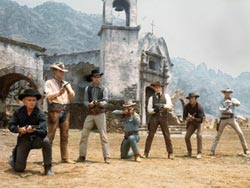
Of the three, my vote always goes to The Magnificent Seven. Six of the seven are long-time gunslingers who know that their way of life is rapidly moving toward extinction. The seventh is a young man, Chico, who longs for the glamour and adventure he thinks a gunfighter’s life holds. Besides treating us to Elmer Bernstein’s incomparable score, in this video we see that these men know who they are and they show us what makes them unique to their time and place.
Based on Japanese director Akira Kurosawa’s The Seven Samurai (1954), The Magnificent Seven incorporates the underlying “a man’s got to do” theme only in the sense that fighting is their job. The nomad existence of moving from battleground to battleground is the life that, individually, each of these men has chosen. But, along the way, the western territories have settled down. Jobs for hired guns are few and far between. The big “farmer/rancher” wars are no more. When Chris (Yul Brynner) is approached by a few men from a small Mexican village in need of help to fight off Calvera (Eli Wallach) and his bandits who raid the town and steal food and crops, he rounds up a few men, willing to sign on for a pittance, and they travel into Mexico to do what they do best—work as hired guns. Nobody expects a shoot-’em-up. The plan is that when Calvera sees that the village has protection, he’ll lead his bandits to raid another town. Of course, that is not how things go, and when the seven are given a chance to ride away unscathed, they come roaring back, almost as much to defend what they’ve made of their lives as to free the village.
I decided to write this post when I mentioned The Magnificent Seven to some younger friends and was shocked that they never heard of it. Well now you’ve heard of it. If you have never seen it, watch it now. If you are a long time fan, it’s time to see it again.
Terrie blogs at Women of Mystery. One of her recent short stories can be found in the anthology Crimes By Moonlight and another can be read on the Beat To A Pulp website.
I had a similar experience in a class I took recently. Out of a dozen people, I was the only person who had seen the Seven! Highly recommended to any readers here, fantastic film.
When Brynner and McQueen (Chris and Vince in the movie) are driving the dead Indian to the cemetery, a sniper takes a shot at them from an upper-floor window. McQueen asks, “You elected?” Brynner wiggles his finger through a hole in his hat and answers, “No, but I got nominated real good.” Where have all the good movie lines like that gone?
Great post, Terrie. I first saw this movie many years ago and it’s one of my favorites. And I agree that the three films you mentioned will always be remembered as the best Westerns ever. For me, numbers five and six would probably be The Searchers and Once Upon a Time in the West.
OK, I have never seen any of these. I wasn’t even born yet. But now I want to see Seven. Hopefully it’s on Netflix!!
Adore this one and love Seven Samurai (of course). I do, personally, feel more for these films than the 2 man-alone greats you mentioned, too. Heck, I even love the derivative 13 Assassins, and who can forget the The Three Amigos? Would you say I have a plethora of affections for this trope, jefe?
Hey Kim, not sure if they have the original on Netflix, I do know they have a 90s television remake that had Ron Pearlman in it. Which isn’t a bad watch, but it is no where near this version.
Terrie, this is one of the reasons I love that between my father and grandfather I’ve been forced to watch a lot of these westerns. Though I was always partial to Lonsome Dove, Young Guns, and McLintock!. I just love how often this show is remade. There’s an anime cartoon, though based off of Seven Samurai, and I noticed that Netflix has one with knights called Ironclad, and then let’s not forget Three Amigos…
Love the Magnificent Seven. One of the best movies in the genre ever. Hmm, I might have to track it down this weekend …
I also love High Noon … I’ve never seen Shane. Bad me.
Even though I haven’t seen all of these, I’ve heard of them! I’m always shocked when I talk to someone who hasn’t heard of something that I consider a universal known. I am going to go to my library’s online catalog now and see what they have. Great post Terrie.
Allison –
You must see Shane. Though it’s rather depressing at the end. Did you see the movie Drive? I never thought about how similar they were until I read [url=http://www.criminalelement.com/blogs/2012/03/the-violence-of-tenderness-shane-and-drive-western-noir-romance]this article by Jake Hinkson[/url], at which point I realized they’re basically the same movie.
I agree, Terri. The Seven will always be the best western movie. Not only that, but the score is second only to the one from “The Good, the Bad and the Ugly.”
@ Kim, Kerry and Allison, you can’t let Jerry and me keep running into folks who’ve never seen one or all of the big three. Time to watch. Tell your friends. @Dan, exactly! The Seven is filled with great dialogue just like that!! @John Floyd, definitely agree with you on The Searchers. @cmorgan, I love how you get from Lonesome Dove to The Three Amigos. And Clare simultaniously brings up Amigos. @Earl, the score of The Good, the Bad and the Ugly is slow and haunting, and makes a wonderful use of whistling and sounds by voice. The theme from the Seven is fast and energizing. I contend that they are in two distinct catagories but are both exceptional.
Jack Bates reminded me that there is an episode of Cheers (you young ‘uns do remember Cheers, right?) in which the gang uses the theme of the Seven to get motivated. Here is the clip:
[url=http://www.youtube.com/watch?v=2gmXLKQwAfI]http://www.youtube.com/watch?v=2gmXLKQwAfI[/url]
And then the rest of the day is spent watching Cheers clips… Thanks for that Terrie.
I put SHANE on the To Watch list. My husband is happy, because he’s seen it and we get to have a movie night 🙂
Just recently, in the tv series ‘Blue Bloods’, grandfather Tom Selleck and his father sit down the grandsons to watch the Great American Western, which is, of course, The Magnificent Seven. So many great lines, including Steve McQueen’s “We deal in lead, friend.” (Also quoted in Stephen Hunter’s book PALE HORSE COMING, a great read for any Alan Ladd or Clint Eastwood or Mag 7 fans). And one of James Coburn’s 11 lines, “Nobody throws me my own guns and says run. Nobody.”
Ok, I’m one of the lame ones who has never seen Magnificent 7 (although I have seen Cheers and I did receognize the song when I listened to the clip). Great post Terrie. I will add it to my watch list.
@cmorgan, Cheers clips are, well, cheerful, so I say, “you’re welcome.”
@Allison, enjoy!!
@Wally,thanks for letting us know about Pale Horse Coming, I’ll have to look for it. And Coburn did do silence to perfection. That line sets the tone for the rest of the movie
@Deb, you will consider it time well spent.
The music may be the thing that puts Seven over the top; I agree it is the best of all. The Eastwood movies have great themes, and High Noon has Tex Ritter.
How many stories (Dirty Dozen, e.g.) have followed that ‘collecting the band’ theme? Hundreds. Thanks to everyone for the ideas, the references (any Stephan Hunter book is top notch—One of the great opening pages is in “Dirty White Boys”).
I wore out my VHS tape of Seven; happy for DVD.
Dan, I’m so glad you enjoyed the post and the comments. The Seven is a treasure to be passed from generation to generation.