
And yet . . .
Even as you savor this joy, thorny doubt prickles the back of your mind. Slow down, it says. Pace yourself. Take time to savor every moment you’re together. The road ahead might seem endless, but it won’t be long before you find yourself revisiting old territory where things are familiar and you know what’s waiting for you around every bend.
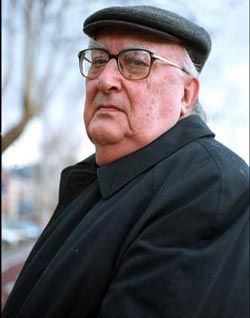
That’s sort of where I am right now with Andrea Camilleri.
He’s utterly unaware of this, of course. But if he knew, I don’t think he’d mind.
Our relationship started when I watched Zen on Masterpiece Mystery last fall. The gorgeous Italian scenery in the series made me wonder why I’d never read any mysteries set in Italy. So I picked up Cabal by Michael Dibdin, one of the Aurelio Zen novels on which the TV series was loosely based. It was good—much better than the TV version. I read a few more and I wasn’t disappointed. Still . . .
As much as Dibdin knew about Italy (and he knew a lot) he wasn’t Italian. The same might be said for the fine Donna Leon. What I wanted was an Italian crime novel/mystery written by an Italian author. One thing led to another, and eventually to Camilleri and his Sicilian police detective hero, Inspector Salvo Montalbano. From the first chapter of The Shape of Water, a 1994 novel that didn’t see U.S. publication until 2002, I knew I’d found what I was looking for. (Police and pasta, what’s not to like? . . .)
To compare Montalbano to Georges Simenon’s Inspector Maigret is easy and apt. Both characters are slightly jaded, middle-aged policemen whose days of foot races and fisticuffs are well behind them. Minions handle the legwork for them now, leaving them free to cogitate—ideally at a favorite café where the chef will happily whip up something special for such an appreciative customer. Both solve their cases swiftly—no muss, no fuss—relying on their wits and their helpful connections. (You don’t reach their levels of seniority without knowing what’s what and who’s who.)
The mysteries are well-crafted puzzles rooted in the vagaries of human nature. Blood and gore are kept to a minimum and the good guys, almost without exception, live to fight another day. It’s all very comforting and satisfying, like the pasta ’ncasciata Montalbano’s housekeeper Adelina leaves in the fridge for him to heat up when he comes home from work.
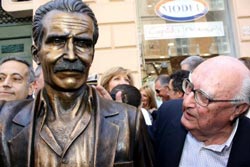
Camilleri came to mystery writing late in life, after a long career directing for stage and TV. He’d readily admit he owes a debt to Simenon’s Maigret—he even worked on an Italian TV series based on Maigret in the 1960s and 70s. Another inspiration is Pepe Carvalho, the Barcelona-based, middle-aged, food-loving detective created by the late Spanish writer Manuel Vázquez Montalbán for whom Salvo Montalbano is named.
There are now 19 Inspector Montalbano novels—some have yet to be translated into English—and Camilleri, who turns 87 in September, is still writing. Il Gioco degli Specchi (The Game of Mirrors) came out in Italy in 2011. An Italian TV series based on Inspector Montalbano has been running since 1999 and was picked up in the U.K.—with subtitles—earlier this year.
At the 2011 Noir Film Festival in Courmayeur, Italy, Camilleri, along with Greek crime writer Petros Markaris, was presented with the Raymond Chandler Award for career achievement. That makes me think that when the time comes for me to dip a toe into Greek crime novels, Markaris might be my man. For now, though, I’m staying in Italy with Camilleri and Montalbano (and with the excellent translator Stephen Sartarelli who makes our relationship possible).
Come join us!
Leslie Gilbert Elman, author of Weird But True: 200 Astounding, Outrageous, and Totally Off the Wall Facts, believes books make excellent gifts. Follow her on Twitter @leslieelman.
I am a big fan of Camilleri having read all of the books translated into English. I like the mixture of politics, food, personalities that are all of the books. I hope the remainder will be available in English soon.
I love Camilleri. I think I’ve read seven or eight of his novels so far. As far as the Greek crime writers are concerned Markaris is the most famous abroad. His novels star an idiosyncratic detective as well.
Jeffrey Siger and Anne Zouroudi also write mysteries set in Greece. Both are good, though their style of writing is very different.
I’m so pleased to “meet” other Camilleri fans! I really do have to pace myself with his books though. I tend to gobble them up. (And really, don’t they make you hungry?)
It looks like Markaris might be hard to find in the U.S., but Montalban’s Pepe Carvalho books are being published (reissued?) in the U.S. this year.
If you’re a Camilleri fan, or simply wondering what the fuss is about, this article from The Guardian says it all:
http://www.guardian.co.uk/culture/2012/jul/06/andrea-camilleri-montalbano-life-in-writing
Became a Camilleri Fan in 2005 ,Devoring his Books..Then Donna Leon…2 of The Best Authors I have ever read…Just Finished “A Question of Belief” Was exceptional ..Of course I read other Authors..But Both Authors are such Brillient Writers..I could exclusively read them..:) Thank you Leslie for your insight…
Thanks Susan!
I met another Camilleri fan at BEA recently. She also said she “devours” his books. There must be a reason these books make us think of food!