
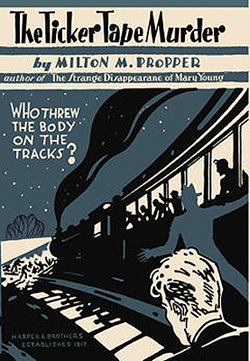
My point (if I haven’t gotten it across yet) is that as much as I like to read books, I am perfectly happy to have them out of my hair when I’m finished with them—either taking them back to the library or trading them back to the used bookstore. In fact, I’d be glad to get all of my books from the these outlets if they would only stock enough of the books I wanted to read. And there’s the catch, since a lot of what I like to read is mystery fiction of a certain age.
Which is not the kind of fiction I’m likely to find at my local library, beyond a small selection of the most obvious choices, things like Agatha Christie, Rex Stout, a smidgen of Dorothy Sayers and a few other big name authors from days of yore. While I’m a great fan of libraries, including our local one, they seem to have decided that no one in this part of the world wants to read old school mystery fiction—aside from those few top shelf names. As for used bookstores, we’re actually rather well off in this part of Arizona as far as that sort of thing goes, but even our fine used bookstores can be kind of hit or miss when it comes to old, relatively obscure mystery fiction.
Then came the Kindle. I have to say that for the longest time I didn’t see any reason why I should require the services of such a device. I’m no Luddite and I’m certainly not averse to the wonders of technology. I do my best to keep up with that sort of thing though I have to confess that I’ve fallen behind when it comes to cell phones, mobile technology, and whatnot.
As an extra special added bonus, since I have a Kindle Fire I can avail myself of a wide range of TV shows and movies. Which, admittedly, is no great shakes when it comes to watching on a screen that’s about the size of my palm, something I’ll probably never do when it comes to movies. But I don’t mind watching an episode now and then of an old mystery TV episode like Ellery Queen or Dragnet, especially if it’s one that I’m not sufficiently interested in to actually shell out the bucks for a DVD set.
I’ve only had my eReader for a short time now, but I’ve already seen the print section of my To Be Read stack dwindle considerably. On the other hand, I’ve managed to accumulate quite a sizable stack of volumes in my virtual TBR pile, the majority of them old dusty tomes from about a century ago. Which is actually a nice blend of the archaic with the latest and greatest in technology and it works out just fine for me.
William I. Lengeman III is a freelance journalist with a fondness for gourmet tea and traditional mysteries. He writes about the former at Tea Guy Speaks and the latter at Traditional Mysteries.
The first three books I put on my new Nook this past Christmas were all from Project Gutenberg,and one of them was The Leavenworth Case, by Anna Katharine Green. It’s high time I went looking for more.
I just took the plunge on a Kindle a couple of weeks ago and I love it. Project Gutenberg is a wonderful resource for old and forgotten treasures. I do wish more classic mysteries were available on ebook/Kindle — hard to say whether the estates are reluctant or whether it’s one of those rights/contracts that get lost in the shuffle.
If a book hasn’t been checked out for a certain length of time, libraries remove them from the catalog. It’s a pain if a book is part of the series and not all volumes are available. My wish is that all books be available in formats suitable for each ereader.
A lot of the much older stuff has entered the public domain, but sometimes there just aren’t knowledgeable people volunteering to transform it into the right formats, which can be tricky. With no chance of royalties–or when considering an older estate’s works, perhaps little chance of huge royalties–it’s often a pure labor of love to make sure the stories are e-vailable. Thanks to everyone at Project Gutenberg!
When I got my kindle the first three things I “bought” were free: the US Constitution, Common Sense by Thomas Paine and a book of Irish Fairy Tales. Thank you public domain. The next book I bought was a collection of mystery shorts by my friend Patti Abbott. I do buy books but I really like the public domain stuff.
I have a wonderful stable of classics on my Kindle – Frankenstein, Pride and Prejudice and the Three Musketeers – but I like new books too especially when I am flying. I just downloaded a short story collection called “The Awareness”. I’m looking forward to that one.
As a librarian who tries to service readers whose eyesight is going, I like the idea of a Kindle to download an older book and then format it into Large Print. We may see fewer large Print as a result of this the e-readers coming along.
You bring up a good point. E-readers make Every Bookinto a large print book, and with the reading capabilities some have, make any book an audiobook.
And when you can download your own documents on them, too, it’s terrific. Currently, these are not all fabulous to listen to, however, I used to work with assistive technology, and the ability to give a visually impaired person better independent access to things like operating manuals, warranties, and bank statements– the junk of everyday life– is a BiG deal. And after dealing with all that, who doesn’t need to relax with a good murder or two?
Aw shucks, Deb, I hope you enjoy The Awareness.
Thank you for the reminder. I have enjoyed a number of P.D. works on my Kindle and look forward to more from Gutenberg.
John