
You can find pictures and complete descriptions of the designs at http://poeboston.blogspot.com/. Let me here discuss them in the order in which I hate them from most to least.
Bonner/Stayner: Their freestanding triangular glass pavilion might be a memorial, a bus stop or a functioning store. It could be a“cenotaph meets ‘gift shop,’ as a Wonderkammer, and as an interpretive center” or place for gatherings.
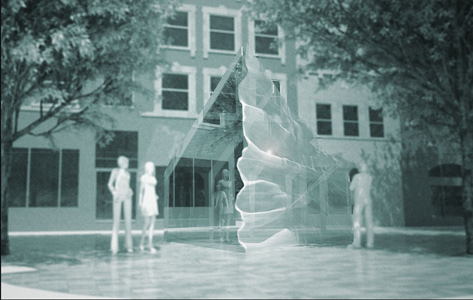
There’s not world enough or time to discuss the pretentiousness of cenotaph and Wonderkammer. But a bus stop? Tell me they’re kidding. The “bus stop,” claim the artists, “avoids the cartoonish kitsch that is embedded in representational monuments.” Really? That must be why they show for sale items including green spectacles, Nevermore anti-blemish cream, and Pin the mustache on the Poe. The structure, the artists suggest, has “multivalent potential meanings. Possibly it is the curtain of the Boston stage upon which his birth parents performed. . . . Maybe it refers to the distortion in Poe’s writing.”
Certainly it’s a mess. Poe in his guise as the Tomahawk Man would have had a field day dismissing this “bus stop.”
Hirsch/Olsson—On a pedestal Poe stands back to back with a shrouded figure.
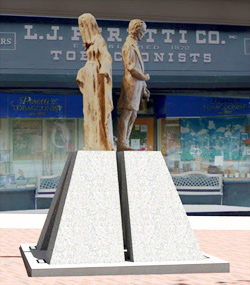
Baloney. If Poe was haunted by anything it was poverty, alcohol, and ambition.
All that’s missing from this statue are the electrodes, so much does it resemble the infamous “Hooded Man” Abu Graib photo. Poe would surely not appreciate the wrongness of the thinking behind this sculpture or the unsuitability of its design.
Rocknak wants to cast a life-size figure of Poe walking through the park.
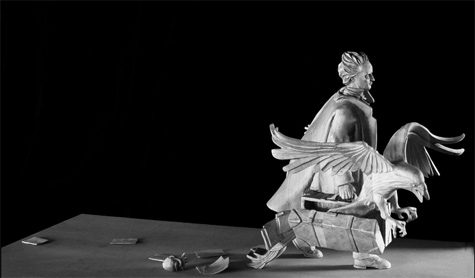
The artist writes that in its design “Boston is not claiming Poe, Poe is claiming Boston. To punctuate this, he leaves a literal paper trail behind him. . . . His ideas are jumping off the page and cascading out of his trunk; a heart lies just behind him, and an oversized Raven explodes to the south.”
I can’t figure out why the heart is left behind; I thought that only happened in San Francisco. And what’s up with that huge raven? It overwhelms the sculpture, its size identifying it as “symbolic of Poe’s brooding creative spirit.”
Enough with this brooding, tortured artist crap; Poe’s contemporaries did not describe him as moody, taciturn, or haunted; we did that, and shame on us.
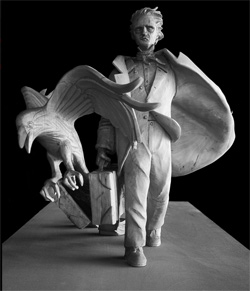
If the purpose of this Boston civic venture is to perpetuate myths about Poe, they’re on the right track.
Poe would have been delighted by a statue in Boston, considering it payback for its treatment of him. But he deserves better than what’s on offer here.
All images taken from Poe Boston.
Susan Amper, author of How to Write About Edgar Allan Poe, still mourns the loss of her Nancy Drew collection.
I guess you are not in favor of the bust stop. I agree with everything you say here. Maybe Boston will rethink the project.
Dear Susan Amper: While I too am not thrilled with two of the
Poe designs (the double-artist ones) and agree with a number of your comments, I think you went a bit over-the-top with your disdain
and, more importantly, should not believe that you could possibly
state how Poe would react to any of the three! You likely could not
have anticipated all his thoughts in the 1840s, and most certainly —
in a new time period of many modern artistic sensibilities — cannot
fully imagine how Edgar’s thinking (and writings) may have changed.
The heart obviously refers to The Tell-Tale Heart, not any city in CA or any aging singer. And it’s entirely legitimate for the raven to be so large —
it is, and always has been, symbolic of his fame & his creativity. The other designs are certainly more cerebral, but that in-and-of itself is
not a negative. Poe did, after all, enjoy a good cryptogram. And to
consider that Poe harbored only dislike for Boston and the literati of
same, is to dismiss his caring for his mother & her career here, as well as the beginning of his literary career. Remember too that to attack Boston (or any major city) and its writers was not simply venom but a way to continue to be noticed, to continue to be part of the public scene, to continue to be read and written about.
Brad Parker (author of LOWELL’S GREATEST ROMANCE: The Saga of Eddie & Annie.)
I agree that the first two are deadly. The third one needs tweaking, but has possibilities. To me, the heart is too literal. If you’re going to have that, shouldn’t there be a cask as well? And perhaps a pit before him with a pendulum over it?
And the raven is wildly oversized. It’s as if it’s more important than Poe himself. I think the statue of Poe striding through the square, leaving his literary imaginings to float along and spread out around him would have been enough.