
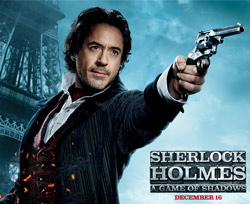
 I like testosterone. Always have. If you like your testosterone served piping hot, with more than a splash of Tabasco, a creamy dollop of ultraviolence, and a healthy slice of goggle-wearing, tin car-driving, machine gun-wielding steampunk pie for dessert, look no further than this film.
I’ve a rather rueful confession to make: I collect Sherlock Holmes pastiches (including the ripely terrible ones) and would probably think fondly of a wet paper bag on the side of the road so long as it had the words “Sherlock Holmes” written on it. That being said, did I enjoy Sherlock Holmes: A Game of Shadows, the latest installment in the ever so brawny Ritchie franchise?
Yes. I enjoyed it like a house on fire. In many aspects I loved it, and in one single aspect, the storytelling improves on Arthur Conan Doyle. Heresy! you shout, but I’ll come back to that.
There are SPOILERS ahead, nothing too drastic, but a few salient points. Without giving the Game away, of course.
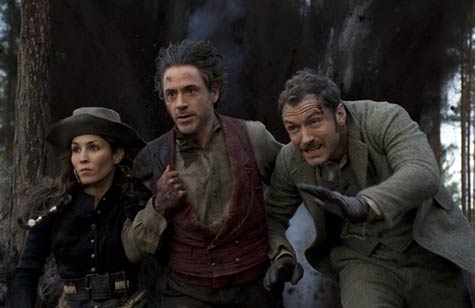
No.
That Sherlock Holmes is the world’s most cerebral hero seems largely irrelevant at this point. The Warner Brothers franchise possesses its own magic, plays its own game and plays it to the delight of its audiences—provided one does not feel overly sentimental toward trees, as many, many trees are harmed during the course of this film.
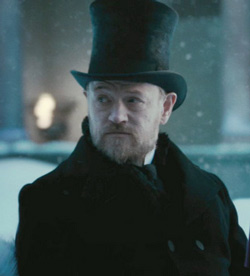
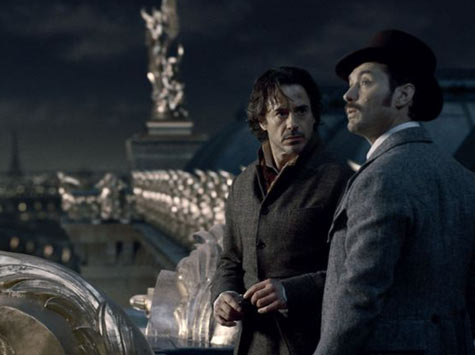 So let us not speak of the Sherlock Holmes who was languid and dreamy, playing his Stradivarius in his doldrums and quietly humming Chopin ditties. This is not that guy. Opera is discussed briefly between Downey’s frenetic Holmes and Jared Harrison’s wonderfully fiendish Professor James Moriarty, but they aren’t kidding anyone—the screamingly obvious chess game metaphor (yes, they play a game of chess while Europe hangs in the balance) is the proper gravy for this meaty slab of action heroism.
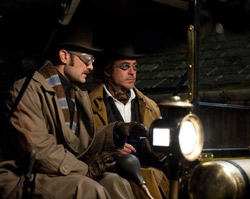 The look of the new film, like the first, falls somewhere between Victorian England as designed by Janis Joplin and what the inside of Samuel Taylor Coleridge’s head looked like during a nasty absinthe binge.It’s arresting, unique, delightfully gritty, and occasionally even beautiful. Bullets scream past in slow motion, bones are broken in balletic choreography, and explosions bloom like heady desert flowers in the grimy stone landscape. There are many explosions. (My friend counted 24, if one includes the end credits and discounts bullets simply shattering the hateful, hateful trees apart.) This creates a perilous playing ground for our Holmes and Watson to dash about in, and their exploits feel rather like watching a pair of perfectly matched ice skaters navigate speed and sharp blades.
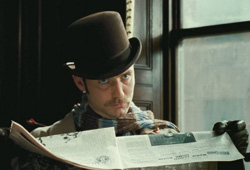
Speaking of Professor Moriarty, Sir Arthur Conan Doyle’s “The Final Problem” could easily be taught in schools as an example of How Not to Write a Short Story. Doyle loathed Sherlock Holmes to such an extent when he decided to murder him at Reichenbach Falls (and Game of Shadows is a Reichenbach retelling) that he penned a narrative in which the villain never appears save for secondhand accounts and a glimpse at a train station, and is likewise hacked off at the knees when our heroes discuss the man. “You have probably never heard of my super duper scary arch-nemesis Professor Moriarty?” Holmes asks Watson. “Nope,” says Watson. (Paraphrasing mine). Wrong answer.
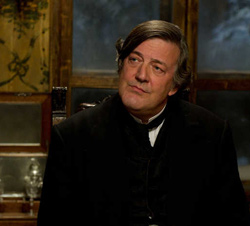 If I have a single overarching objection to this movie, it isn’t to do with the almost gleeful violence and the salient fact that railway conductors simply do not blithely continue to drive trains when half the cars have exploded. It’s not even the fact that Stephen Fry’s hotly anticipated Mycroft Holmes is employed exclusively for lowbrow comic relief when he has about the highest brow of any living British actor. It’s the fact that women—who were held at arm’s distance in the original tales, but managed wonderful heights of bravery and selflessness nevertheless—herein exist to be bullied.
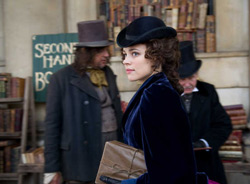
So it’s all about the boys. Fine. How are our boys doing?
Jude Law’s Dr. John Hamish Watson bears such an enormous resemblance to the army doctor of the original tales that one can almost forget the fact we’re not in Kansas anymore, right down to the wearied limp. He’s a man everyone likes, because he’s courageous and game and wearily tolerant of madness. (The fact that none of his friends show up to his stag party is predictably Holmes’s fault.) There’s a fine moment during a gratuitously gory scene in which Holmes is being tortured by Moriarty and a meat hook comes into play, and Watson’s solution to the Colonel Sebastian Moran problem is one that would only occur to an Afghan war hero with balls of steel. He’s invaluable, to both Holmes and the movie. In fact, he’s more explicitly invaluable than many lesser Holmes adaptations in which John Watson is either mocked or irrelevant. I say three cheers for the army doctor. Why shouldn’t he be the most important character in the film?
It isn’t a new idea that Watson broke Sherlock Holmes’s heart a little by marrying and moving away. No matter what spectrum of sexuality you posit for the world’s only consulting detective, his self-confessed only friend moved out of his sphere, and when Holmes returned from the dead to find Watson a widower, he promptly bought his friend’s medical practice through a distant cousin, for more than its market value, so as to return Watson to 221B with the speed of carefully greased lightning. That Holmes loved Watson is canon. (I refer skeptics to “The Adventure of the Three Garridebs.” Don’t blame me, I didn’t write it.) The Downey version alternate universe takes that relationship and adds many nudges, countless winks, half-dressed men in compromising positions, and dancing.
Yes. Dancing.
They dance.
Arguably, there are moments in Game of Shadows, rampantly bromantic as it is, that greater resemble Downey being droll than Downey playing Sherlock Holmes. But what I like best about Downey’s portrayal of a man bereft isn’t the camp, it’s the quiet. The camp is good fun, and it’s entertaining to learn that aquamarine really isn’t Sherlock Holmes’s shade of eye shadow.
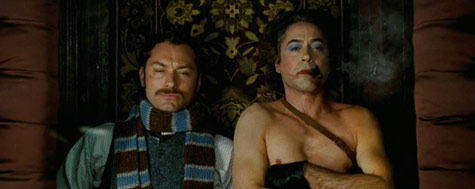
(Note: aquamarine really, really isn’t Sherlock Holmes’s shade of eye shadow.)
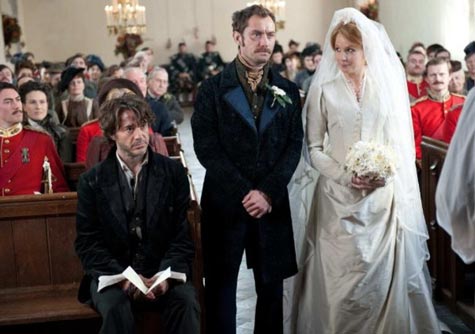
No, where the camp leaves off being grotesque and becomes a study in loneliness, moments of actual poignancy are achieved in what is otherwise a powder keg full of glitter. Downey’s Holmes lives life on the razor edge of sanity and addiction and is nearly killed four or five times a day. When he asks Watson just before the stag party whether Watson’s absence means he’ll die alone, it’s no light question. He delivers Watson to his wedding hung over and bloody, but delivers him nevertheless, and watching him witness the marriage ceremony is ten times more excruciating than watching him dangle from a metal hook like a steer carcass.
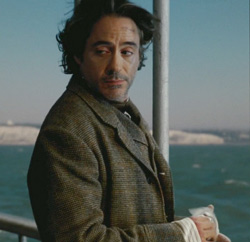 It seems slightly cheap, historically speaking, that this Holmes gets to mourn the loss of his partner in mayhem so openly during an era when homosexuality—real or perceived alike—was punishable by hard labor and the instant ruination of one’s reputation and career, and Oscar Wilde did a solid stint at Reading. I spent several moments during the film marveling a bit at the revisionism, the civil rights advocate in me muttering you got arrested for that sort of thing. But in the cheekily exploding fairyland of Hollywood imaginings, all is permissible, and it’s entirely appropriate that Holmes’s isolation forms the spine of the entire character arc.
“I see everything,” Downey’s Holmes says at the Swiss ball where he must avert an international crisis. “That is my curse.” It’s a moving moment. Like the first film, Game of Shadows ultimately succeeds not due to the heady pyrotechnics of its special effects, or its shamelessly imaginary world of clockwork weaponry and slow-motion derring-do. Rather, it succeeds because genius is uncomfortable, and requires a steady companion upon whom the man of brilliance can thoroughly rely, and that story will always be compelling, no matter how many trees have to shatter apart in the process.
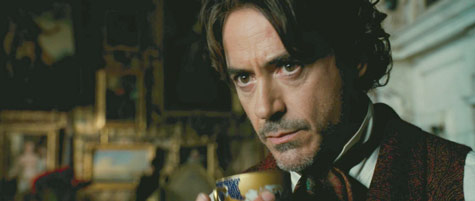
If you hate trees, really detest them, you will enjoy Game of Shadows immensely. But you will also enjoy Game of Shadows immensely if you love Sherlock Holmes, and that ultimately is what matters to the girl with the mountain of pastiches in her library, and the little Sherlock Holmes ornament winking at her from the Christmas tree as she types.
All photos from Warner Bros., unless otherwise credited, but several images specifically via Clothes on Film, who perform a wonderful costume analysis.
Lyndsay Faye, author of Dust and Shadow and The Gods of Gotham, coming Winter 2012 from Amy Einhorn Books/Putnam. She tweets @LyndsayFaye.
I am not a purist about much, but I am about Holmes. For my money, I prefer Stephen Moffit’s modern retelling with Benedict Cumberbatch to RDJ’s “hollywoodized” Holmes of James Bond meets Wild Wild West.
P.S. Loved “Dust and Shadow.” One of the best Holmes pastiches I’ve read. I also recommend “The Sherlockian” and the “Holmes on the Range” series.
I enjoyed reading your review, but I agree with the previous comment. I loved the first movie (totally and completely), but this sequel (though it was a fun night at the movies) was [url=http://www.anglophiledelights.blogspot.com]a bit overdone for me[/url]. Too much testorone and not enough Holmes, I suppose.
However, Law’s Watson was brilliant. His portrayal is right up there with the best Victorian portrayals. And, I agree with your assesment of the use of Mycroft.
Ditto on the “Dust and Shadows” comment too. Have really enjoyed the only two pastiches I’ve read…yours and “The Sherlockian”.
If you like shoot-em-up action movies with lots of explosions and jumping around, you will like this movie. If you are looking for Sherlock Holmes, you will find him in your local library, not here. Sure, there are references, but not many. Lindsay, would Sherlock Holmes toss aside Irene’s handkerchief? Stephen Fry knew better, I can only think he was channeling Winston Churchill, and altho Watson was the best thing in this violent mish-mosh, I think the whole thing was greatly self-indulgent on many levels by many people. Sorry, it’s thumbs down and I’ll wait for Cumberbatch and Freeman.
Splendid review in substance and style alike. For me the most poignant moment in the film was one that, in contrast to so much else in the film, was deliberately underplayed — the scene depicted in the next-to-last photograph in your review. (Would I reveal a spoiler? No freaking way.) I agree that the BBC SHERLOCK is slightly more Sherlockian than the Downey movies, and that Benedict Cumberbatch is a stronger and more canonical Holmes than is Downey, but I also like Downey’s take on Holmes as a brilliant, unstable man teetering on the edge of madness and self-destruction. And Jude Law stands as one of the four best Watsons ever — along with the late Edward Hardwicke and the still-living David Burke and Martin Freeman. My only real complaint about these movies is that sometimes Guy Ritchie so loves his toys that they get in the way of the story and the characters. Perhaps someone could encourage him to calm down just a bit and spare us all of the close-up shots of firing-pins hitting gunpowder-pans and the slow-motion shots of shells blasting trees into toothpicks.
Thank you for a glorious review, and I agree completely. I love both of Robert Downey Jr.’s Holmes movies, and to me he will now always be my Holmes, far more so than Cumberbatch’s rather cold fish or Brett’s coolly classic version. (Cumberbatch “canonical,” as the post says above? I rather think not – and we could raise a few glasses at a local pub and discuss for hours why I think not and why you may disagree…).
For all the potshots the Downey Holmes films have taken, RDJ’s IS a beautifully canonical Holmes (and I’m no latecomer to the canon – I have loved it and re-read it innumerable times since childhood, and wrote my master’s thesis on an aspect of it). But the Ritchie/RDJ version is also a gleefully inventive and wildy subversive, blowing the stodgy dust off one of the best-known characters in Western fiction and turning him on his ear, updating him for a modern audience while still staying true to the heart of what Sir ACD created. The impact these movies have had on bringing Sherlock Holmes alive for new audiences all over the world cannot be overstated. They in effect kicked off and rebooted the whole “modern Holmes renaissance” that gave birth to BBC’s Sherlock, and now Elementary as well (not to mention Monk, The Mentalist, etc., etc.). And while the BBC Sherlock audience may be devoted, in terms of the the vast media world a BBC/PBS audience is pretty darned small – 7M, 8M maybe per broadcast — while the RDJ movies have reached many more mega-millions throughout the world.
I think sometimes the Ritchie/RDJ movies do not get their fair share of accolades, and I’m pleased to be catching up to Lyndsay’s lovely review here. I met RDJ recently at a Hollywood event and we talked Holmes for a while — he is very much invested in the character creatively, and shared some of the moments in the films that were his own improvisations. He said if it’s up to him, he feels that Holmes is a part he would be delighted to play for many, many years to come. Here’s hoping so, and that the films can continue to delight new generations of Holmes fans, and send brand-new fans scurrying to their bookstores to read the canon.
I love the stars in this film and think that Robert Downey Jr. and Jude Law are a dynamic duo. Can’t wait to see this one endless times too.
Ms. Faye,
First, allow me to congratulate you on producing what I have been telling people is hands-down the best modern Holmes pastiche. You have mastered what I call the “Watson Voice” to a level I have not seen elsewhere (and I’ve read a lot of Holmes pastiches). Additionally, you achieved your vision without allowing our favorite crime-sleuthing duo to do anything out of character, which rarely happens with the post-Doyle authors. Kudos!
Regarding Game of Shadows, we agree on almost every point. I would have preferred more detecting and less Jason Bourne-ing. The wonderful Kelly Reilly was underutilized, criminally so (although I will have to concede that, perhaps, her level of involvement was appropriate to the story Ritchie was telling). Rachel McAdams–and Irene Adler–were both used shabbily (so much so that I’m actually hoping for an “I was in the shower and last season was a dream” moment in the next film). Honestly, the entire scene in the restaurant felt contrived, and could have been excised from the film without impact. And, while I enjoyed Noomi Rapace, her character read like a generic–and forgetable–Bond girl.
So, I believe we are in agreement that perhaps in the third film, our ladies are treated with a bit more respect. (Personally, I would love to see the next film combine The Empty House and The Sign of Four, so we can get more of the amazing Ms. Reilly.)
Where we disagree (and apparently, where my lady and I disagree with virtually everyone else on the planet) was the performance of Jared Harris. We’ve no problem with the scripted character of Moriarty; his alleged performance of same, however… We never got the sense of his evil, his malice, his threat. He was never a Holmes-worthy villain. (For that matter, he was never a Marmaduke-worthy villain.) My mother would have made a more believable, realistic Moriarty…and she’s neither an actor, nor alive.
I agree with you that Moriarty, as written by Doyle, was an ill-defined afterthought. It is only in the post-Doyle literature that he achieved his stature as the ultimate Holmesian big bad. I also understand that, for this film, an actor was required of whom we could believe would be a physical match for Downey, and still be innocuous enough for us to believe he hobnobbed with heads of state. However, my lady and I believe Harris’ casting was an epic fail on all levels. From our positions as arm-chair quarterbacks, we came up with at least three better choices: Sir Patrick Stewart (who physically resembles Paget’s version of the character, and who still, at age 73, is in better shape than I am at 50 and looks like he could take on Downey and myself combined), Timothy Dalton (the first Bond I really believed was dangerous), and Jason Isaacs (younger Timothy Dalton). You wouldn’t have to change a single scene, a single bit of dialogue from the original film; just CG one of these actors (or almost any other actor) over Harris, and Game of Shadows would be a better film.
Again, I know we disagree on this last point. However, for us it was the single most dissatisfying thing about the sequel. For this reason, we are hoping against hope that Moriarty remains dead in the next film.
Thank you for tolerating my rant. And, please write another Holmes tale!
“Great information joy & hope and peace all is so nice advice for us , thanks for sharing it give us the first opportunity to visit this website along with you .
We Provide lots Of Printing & Branding services or printing and packaging, such as all kinds of books,
custom branded merchandise, company logo merchandise, custom board books ,and other t shirt and cap printing products, etc