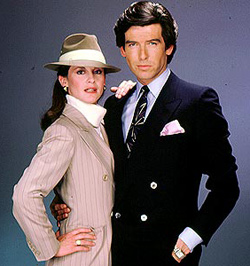
Remington Steele and Laura Holt: Gotta love the hat.Try this for a deep, dark secret: the great detective, Remington Steele? He doesn’t exist. I invented him. Follow. I always loved excitement, so I studied, and apprenticed, and put my name on an office. But absolutely nobody knocked down my door. A female private investigator seemed so… feminine. So I invented a superior. A decidedly masculine superior. Suddenly there were cases around the block. It was working like a charm… until the day he walked in, with his blue eyes and mysterious past. And before I knew it, he assumed Remington Steele’s identity. Now I do the work, and he takes the bows. Its a dangerous way to live, but as long as people buy it, I can get the job done. We never mix business with pleasure. Well, almost never. I don’t even know his real name!
Remember Remington Steele (1982-1987)? It may not seem like such a big deal now, but it was the first show I’d ever seen in which a woman was a private detective with her own business—and unlike in Hart to Hart (1979-1984), a series which overlapped with Remington Steele, the PI heroine, Laura Holt, wasn’t married to her wealthy business partner. It was different in other ways, too. Like the “dramedy” M.A.S.H. (1972-1983), the show blended genres: detective show, romantic comedy, and sometimes straight-out drama. Today it’s a real experience to re-watch the series and recognize so many of the guest stars: Dorothy Lamour, Sharon Stone, Delta Burke, Geena Davis. Not to mention everyone’s 1980s wardrobe and hair…but the stories, and the central romantic relationship, still hold up.
To cases solved and cases yet to come.
Early in the 1980s, it was unusual to find a character like Laura Holt on network television. Laura was her own woman, responsible for her own destiny. True, the show also focused heavily on the romance between Laura and con man “Remington Steele,” but even when Steele took the lead in their relationship, Laura always kept her hardheaded approach to investigating. It’s often described as a forerunner of Moonlighting, but despite the brilliance of that show’s dialogue, I confess I still prefer Remington Steele. To me, it’s less stylized and more groundbreaking than its successor, especially in the matter of the romance. It’s still the role for which I remember Stephanie Zimbalist best.
Most people probably remember the show as Pierce Brosnan’s breakout role in the U.S., and the role that lost him the role of James Bond—first time around—to Timothy Dalton. Brosnan’s comedic timing (and later that of Doris Roberts, who played Mildred Krebs) was a major part of the show’s charm. The humor of the show harkened back deliberately to the Hollywood movies of the 1930s and 1940s, both in Steele’s frequent references to movies and in the style of Steele and Laura’s relationship.
I think we’re alone now…Remington Steele: I realize trust is not something bestowed, but earned, and on the face of it, I’ve done nothing to earn yours.
Laura Holt: Notice how I’m not jumping in to argue with you?
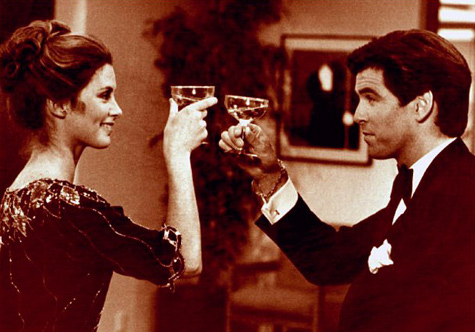
Laura and Steele had their Hollywood-style banter going from the first aired episode. It’s especially fun because their conversations always have an edge: Steele is lying about his identity, and Laura knows it. (In fact, his true name was never revealed.) He’s a (possibly former) criminal, and she’s a detective on the side of law and (decidedly) order. She’s the hardworking creator of her agency, he’s the figurehead who stepped in without her assent. He’s a skilled player of different roles; she has to try and discover which of those roles is his true self (she is a detective, after all!). Meanwhile, Steele has to struggle against a lifetime of concealment in order to attain what he wants: a relationship with Laura.
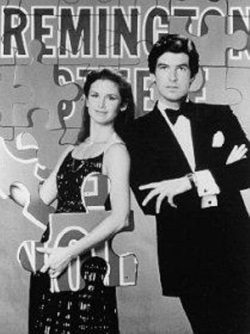
Solve the puzzle…Laura Holt: What should I call you when we’re alone?
Remington Steele: Well, I’m quite used to the name that you came up with.
Laura Holt: It’s from a typewriter and a football team.
Remington Steele: Then pick one. I’ve probably used it.
All of these tensions deepen the meaning of even their most genial banter. In any romance, learning to trust the other person is a key element. In their romance, it isn’t just romantic trust at stake. For Laura, the question of trust is one that defines her deepest beliefs and her hardwon career; for Steele, it’s tied to his desire for redemption.
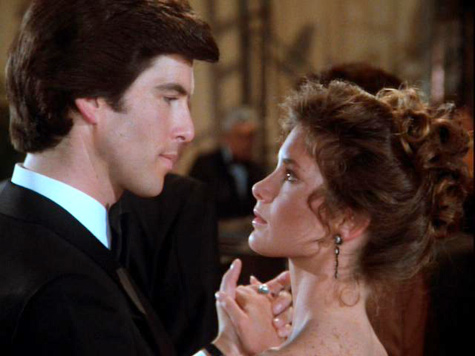
Such a beautiful couple.
They’re not just solving cases; they’re solving each other.
Victoria Janssen is the author of three erotic novels and numerous short stories. Her latest novel is The Duke and The Pirate Queen from Harlequin Spice. Follow her on Twitter: @victoriajanssen or find out more at victoriajanssen.com.
Interesting.
I only vaguely remember this show. (I rarely got access to a TV in the 80s.) I’d like to hope the opening gambit is dated, though. I’d like to hope a woman could stick “Laura” on the door (as opposed to Kinsey or V.I.) and get people to knock now. Then again, PJ Parrish still has people who won’t read the books when they find out sisters wrote them instead of a “dude.”
I think now it’s pretty commonplace to have a female PI – and I am sure there were some in the 1980s as well. But I do think that they might have had trouble getting clients.
Incidentally, there are some episodes of the show that can be streamed for free online, if one doesn’t want to commit to a set of DVDs.
Wow, total blast from the past. I was a big fan as a kid, though I can’t remember much about it beyond the banter and the PI storylines. Might need to look up some DVDs and reaquaint myself with the series. Anybody know whatever happened to Stephanie Zimbalist?
Great post, Victoria. Growing up in the 80s, I loved this show. Of course, a big part of it was Bronsan’s charm, but you really put your finger on what made the show so interesting. Laura Holt was a great character and Zimbalist played her with such pluck. She was really the eyes through which the rest of us observed Steel. And, of course, the central irony of the show was that she was the real detective.
@Jake, it was interesting re-watching some of the eps – I had forgotten that, very very gradually, Steele was actually learning some things about detecting from Laura! I thought it was great that she was teaching him rather than the other way around.
Jennifer
July 27, 2011 at 5:37 pm
God, I loved this show. Laura Holt was so awesome.
As for Mr. Steele, uh… all of my exes have a certain resemblance in one way or another to that fellow. SERIOUSLY. I guess he was my formative “who you get hot for” fellow in my love map.
I love this show, have all the DVDs and have re-watched them several times. I agree that the episodes hold up. Laura was an inspiration to me as a teenager in the ’80s. I wanted a VW Rabbit and started wearing hats. Her smarts, her spunk, her hair–what’s not to like?
I nurtured a minor crush on Brosnan, but not because of his looks. Steele’s clumsiness and cluelessness when it came to detecting (at least in the beginning) was endearing. Oddly enough, when Brosnan became Bond and was all suave with the babes, I lost interest.
Loved this show, too! I was in the right place to sigh, and frequently. Hit me right in the smart-responsible-girls-can-TOO- get-sexy guys. SZ was hardly a troll, I admit, but she was so driven that she could be a pill at times. I liked the way he loosened her up and the way she kept him living up to the man she’d invented. I’m with Laura and PCN- this formula gets me. Where’s my new one? Don’t say Chuck- seems different to me.
@Jennifer – LOL! Hopefully, yours all had actual names….
@Pop Culture Nerd – you are so right about that – if Steele had been dominating, he would have been much less interesting all around.
@clare2e – I love that each of them had something to give the other.
Kiersten
July 28, 2011 at 4:59 pm
I LOVED this show, especially when they were in Ireland and RS’s past would loom and endanger them. Such good stuff. Laura Holt was a true trailblazer in TV at that time & while I loved me some Moonlighting, totally prefer RS.
Am I too much of a nerd to say that Pierce turned down/didn’t get the James Bond more because his wife was dying from breast cancer than b/c of RS (though that too was a factor)? Bronsnan didn’t want to be away from her and his sons for as long as the 007 shoot was going to take while she was going through that.
Sometimes, I know way too much meaningless trivia.
I also love this show. It’s such a great premise, and it was really fun to watch. I have the DVDs.
@Kiersten – the Ireland shows were fabulous and you aren’t a nerd!
Little Red
March 30, 2012 at 3:23 pm
I just discovered this show last year. I remember it being on during the eighties but somehow I never got around to watching it even though I loved Moonlighting. After watching a season and a half through Netflix, and then through season three on Hulu, I just bought the complete DVD set outright.
Laura Holt is a great female lead character and not just an appendage to the male lead. She’s a wonderful role model for young girls in not giving up their dreams. Pierce as Steele was incredibly charming and had wonderful comedic timing in the role. Steele grows up and into the role that Laura had created. He goes from being a mere figurehead who occasionally and accidentally contributed to solving the case to an integral part of the team as a real detective.
I too loved this show but only season one. When they got rid of Murphy and Bernice it changed the dynamics of the show. Season one reminded me of the Thin Man series with William Powell and Myrna Loy. When they made changes in season two replacing James Read and Janet Demay and added Mildred Krebs I lost interest.

Interesting.
I only vaguely remember this show. (I rarely got access to a TV in the 80s.) I’d like to hope the opening gambit is dated, though. I’d like to hope a woman could stick “Laura” on the door (as opposed to Kinsey or V.I.) and get people to knock now. Then again, PJ Parrish still has people who won’t read the books when they find out sisters wrote them instead of a “dude.”
I think now it’s pretty commonplace to have a female PI – and I am sure there were some in the 1980s as well. But I do think that they might have had trouble getting clients.
Incidentally, there are some episodes of the show that can be streamed for free online, if one doesn’t want to commit to a set of DVDs.
Wow, total blast from the past. I was a big fan as a kid, though I can’t remember much about it beyond the banter and the PI storylines. Might need to look up some DVDs and reaquaint myself with the series. Anybody know whatever happened to Stephanie Zimbalist?
From her website, it looks like she mostly does theater these days, with some tv guest spots.
Great post, Victoria. Growing up in the 80s, I loved this show. Of course, a big part of it was Bronsan’s charm, but you really put your finger on what made the show so interesting. Laura Holt was a great character and Zimbalist played her with such pluck. She was really the eyes through which the rest of us observed Steel. And, of course, the central irony of the show was that she was the real detective.
@Jake, it was interesting re-watching some of the eps – I had forgotten that, very very gradually, Steele was actually learning some things about detecting from Laura! I thought it was great that she was teaching him rather than the other way around.
God, I loved this show. Laura Holt was so awesome.
As for Mr. Steele, uh… all of my exes have a certain resemblance in one way or another to that fellow. SERIOUSLY. I guess he was my formative “who you get hot for” fellow in my love map.
I love this show, have all the DVDs and have re-watched them several times. I agree that the episodes hold up. Laura was an inspiration to me as a teenager in the ’80s. I wanted a VW Rabbit and started wearing hats. Her smarts, her spunk, her hair–what’s not to like?
I nurtured a minor crush on Brosnan, but not because of his looks. Steele’s clumsiness and cluelessness when it came to detecting (at least in the beginning) was endearing. Oddly enough, when Brosnan became Bond and was all suave with the babes, I lost interest.
I loved this show. I think I had a thing for shows of its type, though, since both Moonlighting and Scarecrow and Mrs. King also top my list of faves!
Great post. I love this show I was a big Remington fan and a huge fan of Hart to Hart. Both so much fun.
Laura, we must be twins. I have the DVD sets of Moonlighting and Scarecrow and Mrs. King, too!
Loved this show, too! I was in the right place to sigh, and frequently. Hit me right in the smart-responsible-girls-can-TOO- get-sexy guys. SZ was hardly a troll, I admit, but she was so driven that she could be a pill at times. I liked the way he loosened her up and the way she kept him living up to the man she’d invented. I’m with Laura and PCN- this formula gets me. Where’s my new one? Don’t say Chuck- seems different to me.
@Jennifer – LOL! Hopefully, yours all had actual names….
@Pop Culture Nerd – you are so right about that – if Steele had been dominating, he would have been much less interesting all around.
@clare2e – I love that each of them had something to give the other.
I LOVED this show, especially when they were in Ireland and RS’s past would loom and endanger them. Such good stuff. Laura Holt was a true trailblazer in TV at that time & while I loved me some Moonlighting, totally prefer RS.
Am I too much of a nerd to say that Pierce turned down/didn’t get the James Bond more because his wife was dying from breast cancer than b/c of RS (though that too was a factor)? Bronsnan didn’t want to be away from her and his sons for as long as the 007 shoot was going to take while she was going through that.
Sometimes, I know way too much meaningless trivia.
@Kiersten – I didn’t know that! Thanks for the info.
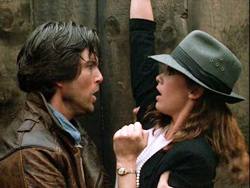
I need to re-watch the first Ireland ep – I didn’t before I wrote the post. Though that scene with the spiked fence has, umm, stuck with me.
I also love this show. It’s such a great premise, and it was really fun to watch. I have the DVDs.
@Kiersten – the Ireland shows were fabulous and you aren’t a nerd!
I just discovered this show last year. I remember it being on during the eighties but somehow I never got around to watching it even though I loved Moonlighting. After watching a season and a half through Netflix, and then through season three on Hulu, I just bought the complete DVD set outright.
Laura Holt is a great female lead character and not just an appendage to the male lead. She’s a wonderful role model for young girls in not giving up their dreams. Pierce as Steele was incredibly charming and had wonderful comedic timing in the role. Steele grows up and into the role that Laura had created. He goes from being a mere figurehead who occasionally and accidentally contributed to solving the case to an integral part of the team as a real detective.
It’s such a fantastic treat to (re)discover a gem, isn’t it?
I too loved this show but only season one. When they got rid of Murphy and Bernice it changed the dynamics of the show. Season one reminded me of the Thin Man series with William Powell and Myrna Loy. When they made changes in season two replacing James Read and Janet Demay and added Mildred Krebs I lost interest.