
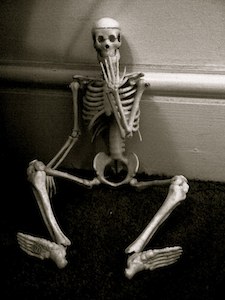
People are certain of it, but it’s absolute piffle.
“What about ‘The Fall of the House of Usher’?” they demand. “‘The Tell-Tale Heart,’ ‘The Black Cat’? All that decay and madness and death.’”
My response: First, these are but a tiny minority of Poe’s tales. The overwhelming majority are either flat-out comical or subtle goofs. “Usher” and “Black Cat” you say? But what about “The Duc de L’Omelette,” “Never Bet the Devil Your Head,” “The System of Doctor Tarr and Professor Fether,” “The Literary Life of Thingum Bob, Esq.,” or “Why the Little Frenchman Wears his Hand in a Sling”? If a man writes 60-plus tales, and the only ones people read are a handful of “dark” ones, does that tell us what kind of writer he was, or what kind of readers we are?
As for those “melancholy” tales, they are not at all what they appear. To make short work of it, they are goofs. Fakes. Send-ups. Tales meant—in Poe’s terminology—to “diddle” us.
What? “The Fall of the House of Usher” a goof? Um, yup. Affirmative. Righto. Yes indeedy.
In “Usher” Poe crafts a “tale of sensation,” in the older meaning of the word: a story that emphasizes the sensations—in this case of horror—of the characters. But beneath that tale he buries a burlesque (and also, I believe, a murder mystery). Most readers, caught up in the narrator’s terror, fail to notice the sly understory, but it’s there.
If this is hard to believe, before you go back to the tale itself, check out Poe’s “How to Write a Blackwood Article.”This will tell you more about where he was coming from than ten readings of “Usher.”
Blackwood’s Magazine was the 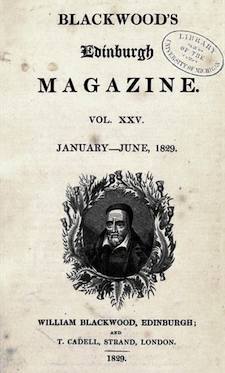
Read the advice Blackwood offers his visitor, and then revisit your favorite dark Poe tale, and see if Poe isn’t doing exactly what he lampoons Blackwood for.
“Get yourself into such a scrape as no one ever got into before.”
“Hint everything—assert nothing.”
“Above all things it is necessary that your article have an air of erudition.” “If you know any big words . . . use them. Talk of the Ionic and Eleatic schools—of Archytas, Gorgias and Alcmoaeon.”
“Put in something about the Supernal Oneness.”
Poe published his lampoon in November of 1838. “Usher” appeared the following September. Can anyone believe that he employed in perfect seriousness precisely the formula he had just finished deriding?
No, “Usher” is a send-up of Blackwood’s, and of the ghosts-from-the-grave Gothic, a genre that for years had been the subject of parody. Poe’s tale is no mere send-up, but send-up it is, for sure.
And if “Usher” isn’t serious, then we need to rethink what Poe was about.
Image via benleto.
Susan Amper, author of How to Write About Edgar Allan Poe, still mourns the loss of her Nancy Drew collection.
Great post. I’ll have to go back to Poe and see how some of his stories play out against your theory. If you’re right, and I think you might be, why has this side of Poe been so long ignored?
mysteryfan: Maybe not so much ignored as buried. Some scholars fear that if Poe was kidding, he can’t be taken seriously. I disagree. Some of his kidding is pandering to the audience of his day, and some of it is also making fun of that same audience. Poe was deadly serious about literature and how words both mean and mystify.
That’s tantamount to saying Hitchcock directed romantic comedy fluff. Wait, early on Hitchcock did direct romantic comedy fluff!
My favorite Poe story has always been (and it’s also one of the funniest of his tales) “The Angel of the Odd”.
Barb: “The Angel of the Odd” is great fun. Parts of it read like a vaudeville act.
Leigh Lundin: I believe that Hitchock’s early movies were never just fluff–like Poe, he was using fluff to disguise the sinister.
Most of Poe’s intial stories were a mixture of homage and parody. The fact that he was never able to get a publisher for his Tales of the Folio Club, as originally conceived, meant that tales ended up appearing separately, and without the context for which they were intended. People tended to take very seriously what Poe only meant as half-serious.
I’m not convinced by the argument. Some of his stories certainly have elements of parody in them, but are still intensely psychological dramas. I would argue still that many of his works are designed to inquire into psychological iniquities, loss, and everything else Poe is famous for, and specifically not humour in the way that the writer of the article intends. I take as my example The Mystery of Marie Rogêt. The article could refer to a few of Poe’s seriously taken works with an argument, but by no means his entire opus, as Susan Amper arguments. I generally loathe those entirely generalising arguments.
If this argument were to be seriously applied to Poe’s opus, it should probably be restricted to his supernatural works. All of his detective and adventure fiction (the Dupin series, Gold Bug etc.) don’t fit the fundamental Blackwood letter style. Same goes for poems (obviously) and goofs (except they are still goofs, just open about it.) But then it seems that you have to exclude a large number of his works in order to apply the parodies argument.
However, Poe was generally verbous and allusive in those works one must concede are not parodies, and not just in order to invent parodies in the Blackwood style. There is a distinction to be made between the level of formulaic verbousity, esotericism, etc. found in his openly parodic tale A Predicament, and that of The Fall of the House of Usher. I think that’s important to note. I also think it provides a strong argument (that I feel the author of the article perhaps would have done better to subscribe to) that Poe wanted to distinguish his psychological experiments in horror fiction from the formulaic Blackwood articles that he satirised in A Predicament. Ultimately, I feel there is a definite difference between the poetry of tales such as The Oval Portrait and Ligeia, as opposed to the open formula to openly comic A Predicament.
I think it’s important to really consider the primary motivator here -money- to truly respect the argument. After receiving a 50$ award for ‘Ms. Found in a Bottle’ early in his literary career,a large portion of the dark “gothic” literature was EA’s way of trying to re-live a peak -a euphoric high fueled by success-in an otherwise impoverished/sickly life.
Poe was not writing dark “gothic” literature–he was making fun of it.
what a load of shite. it takes a truly unsubtle mind to imagine that the imp of the perverse cannot be comical as well as “dark,” or “melancholy,” as you put it (you cannot seem to be able to define that against which you rail, which might be a sign that you’re out of your depth), by turns or even at the same time.
I always tought of Usher as a kind of scientific cautionary tale about endogamy disguised as horror story. The House (and its lord) is the weakened family name/blood/lineage. Do you think too farfetched?